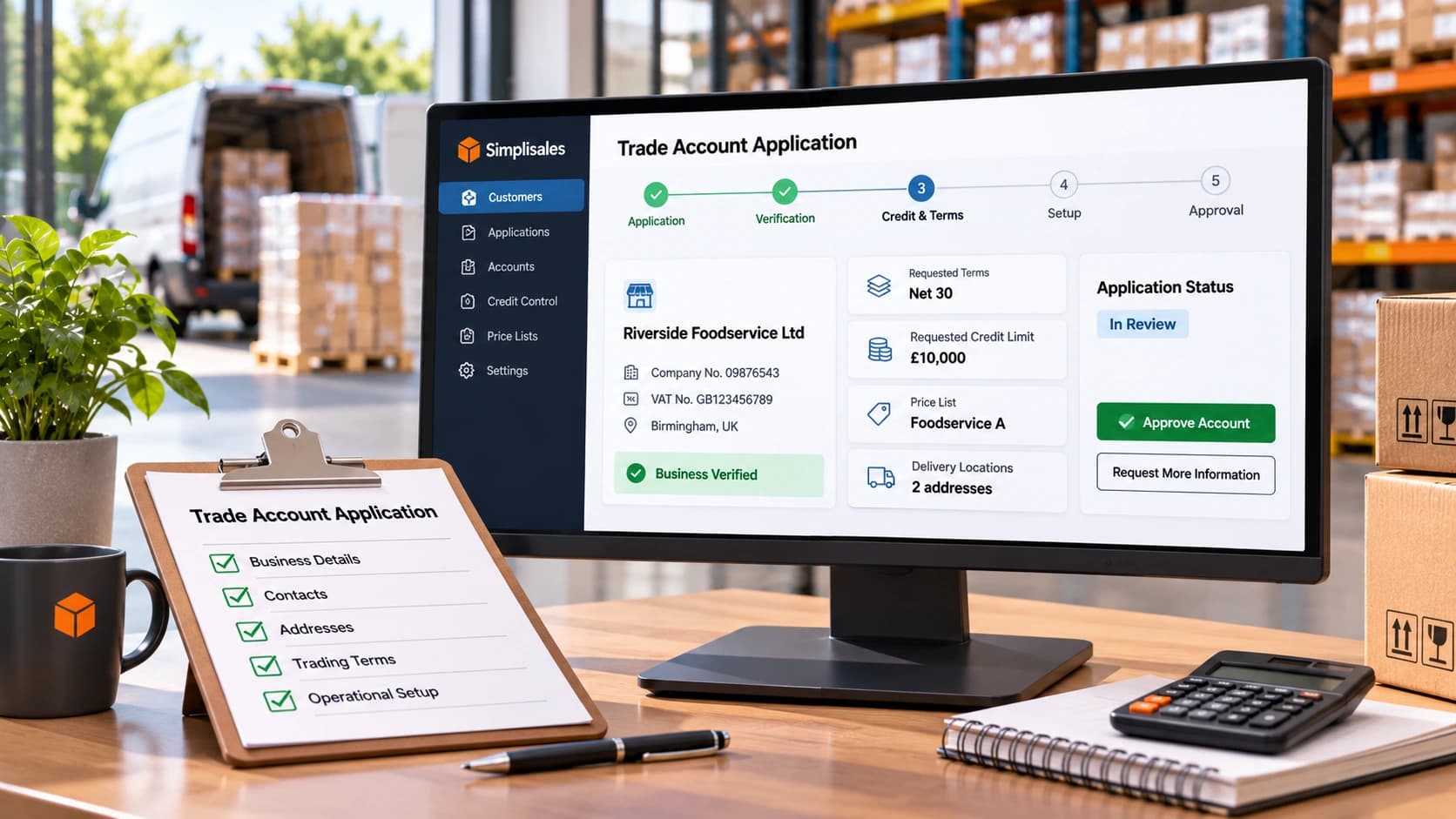

A new customer is filling out a trade account application on your website.
No question, someone copies the details into a spreadsheet. Then sales asks which price list they should receive. Companies House is normally checked by finance. Another employee emails for a delivery address. Two days later, nobody is sure whether the account was actually authorised.
The form was digital. The process was still manual.
And a good trade account application should do more than collect contact details. It should sufficiently inform the buyer, decide how they can trade and switch on the account without restoring the same customer record across several frameworks, in real-world scenarios.
Why trade account onboarding becomes admin-heavy
Wholesale customer setup usually combines several decisions that belong to distinct teams, so finance wants to know who the legal customer is, broadly speaking. Operations needs the correct delivery location. Sales wants the buyer live quickly. It also needs to know whether credit should be offered. E-commerce needs a catalogue, price list and login permissions.
The application becomes a relay race, and though the team repeatedly ask for it, retypes it and constructs it, when those decisions sit in email, probably, in the actual application. Information is once handed in by the customer.
The goal is not “approve every application automatically”. The goal is “make routine applications easy to approve and make exceptions obvious”.
Design the application around decisions, not data collection
Longer forms aren’t automatically safer. Trading rules, fulfilment, or credit assessment: ask why you are mainly requesting it if a field won’t, in many respects, affect verification.
A valuable application usually collects four groups of information: who the business is, who is currently authorised to act for it, where orders will (in practical terms) be billed and delivered, and what commercial terms are typically requested.
Step 1: collect the minimum useful information
| Information group | Typical fields | Why it matters |
|---|---|---|
| Legal business identity | Legal/trading name, company number where applicable, VAT number, business type | Creates the correct customer record and supports verification |
| Contacts | Applicant name, role, email, telephone, accounts contact | Identifies who can order and who receives financial communication |
| Addresses | Registered/billing address and delivery locations | Supports verification, invoicing and fulfilment |
| Trading request | Expected spend, product interest, requested terms/credit limit, PO requirements | Helps route the account to the right commercial review |
| Operational setup | Preferred warehouse/region, delivery restrictions, sales-rep relationship | Avoids manual configuration after approval |
A prepaid customer may require far less credit information than a buyer asking for a large 60-day facility. So don’t ask every new buyer for the maximum possible information just because one high-risk account might need it.
Step 2: verify the business before granting trading access
Companies House is a useful first verification layer for UK limited companies. Its free register shows the registered office, incorporation date, officers, filing history, charges, and insolvency information.
Use that information to check that the application outlines the same legal entity you intend to invoice, in practice. So, in real-world scenarios, staff should review mismatches between the company number, legal name, billing address, and applicant rather than automatically correcting them.
Companies House isn’t a credit score. It also clearly warns that it doesn’t verify the accuracy of all information filed; in real-world scenarios, verification and creditworthiness are complex questions.
Relying on your risk policy, you may also use commercial credit-reference data, trade references or existing group/customer history before generalising credit in real-world scenarios.
Step 3: separate account approval from credit approval
A business can (in practice) be a perfectly legitimate customer without qualifying for an open credit facility on day one, to a significant degree.
This is one of the easiest ways to streamline onboarding. In turn, instead of treating the decision as approve/reject, separate two questions:
- Can this business become an active customer?
- If yes, how is it permitted to pay, and, what’s more, what outstanding balance can it carry?
A new buyer might perhaps therefore be authorised immediately on card, BACS before dispatch or pro-forma terms, in many respects. Thus, another buyer may receive Net 30 with a modest opening limit, reviewed after several months of trustworthy payment history, to a significant degree. At this point, a credit review is continuing separately.
Credit limits should likely follow a documented policy, not the enthusiasm of the salesperson who won the account.
Step 4: assign the customer’s trading rules
Until the operational rules are usually attached to the account, approval isn’t complete.
- Price list or contract pricing.
- Catalogue or permitted product range.
- Payment terms and balance/credit limit.
- Default warehouse or fulfilment location.
- Delivery addresses and applicable delivery rules.
- Named sales representative or team.
- Currency, tax treatment and PO requirements where pertinent.
This is the difference between creating a customer record and creating a customer that can, to some extent, actually trade correctly, in many respects.
Step 5: approve, activate and communicate the outcome
Once the checks are, in practice, complete, the account should move from Pending to Active only when the needed trading rules are in place, in real-world scenarios.
Send the buyer a clear confirmation that explains how to order, their permitted payment terms, any credit limit or prepayment requirement, delivery expectations and who to contact if something is generally wrong, to a significant degree.
Record the reason internally. Even so, orders repeatedly fall onto manual hold if the application is said no or needs more information, on the whole. Don’t leave applications in an undefined state where the buyer can (to a meaningful extent) log in.
Trade account decision table
| Application outcome | Typical situation | Recommended account setup | Next action |
|---|---|---|---|
| Approve — prepaid | Valid business, no credit requested or insufficient history for credit | Active account. Card/Bacs/pro-forma before fulfilment | Allow ordering immediately under prepaid rules |
| Approve — credit | Identity verified and credit policy satisfied | Active account. Agreed terms and starting limit | Monitor utilisation and payment behaviour |
| Approve with lower limit | Business acceptable but requested exposure is too high | Active account. Lower initial balance limit | Review after payment history develops |
| Pending review | Information mismatch, incomplete application or additional verification required | Pending. No uncontrolled credit ordering | Request specific missing evidence |
| Hold/reject | Risk outside policy, unresolved fraud concern or unacceptable existing exposure | No active credit facility. Access restricted as policy requires | Record decision and communicate appropriately |
Automate the workflow without creating blind auto-approval
Automation is most valuable when it removes predictable administration, not judgement.
Like, a process can automatically check that mandatory fields are complete, flag an invalid company number format, route a high requested limit to finance, create a task when tackles don’t match, and preselect a standard price list based on account type, in many respects.
That doesn’t mean every decision should be made by a score with no human review. I mean, the ICO specifically cites automatic refusal of an online credit application as an example of solely automated decision-making that can have a similarly noticeable effect on an individual in practice. Where personal data is involved, businesses need to understand the relevant UK GDPR rules and safeguards.
Where it’s happening, the highest-value automation is often uncomplicated, including speeding up applications and making exceptions impossible to miss, broadly speaking.
Data protection and credit checks
And yet, the customer is a business. A trade application often includes personal information about directors, sole traders, partners, and named contacts.
Collect only what you need, explain how the information will (in actual operation) be employed, secure it appropriately and specify a lawful basis for processing, on the whole. Your privacy information should be transparent about that use, if you use credit-reference data or automated profiling, in real-world scenarios.
The ICO’s legitimate-interests guidance recognises that commercial interests and responsible credit-risk assessment can form legitimate interests in many respects, but the business still needs to consider necessity and balance its interests against the individual’s rights. For personal guarantees, sole traders or more complicated credit arrangements, obtain fitting legal or compliance advice rather than treating the online form as the contract by itself.
Where Simplisales fits
Responses arrive in the Dashboard and can be reviewed or exported without sustaining a separate form-and-spreadsheet process. Simplisales now includes configurable Forms that can be shared publicly or sent directly to picked contacts or trading accounts.
Once a buyer is authorised, the customer profile can commercially rule that find out how the account trades: currency, price list, payment terms, catalogue, balance limit, warehouse and allocated sales team.
Customer status can also control access. Accounts marked pending, suspended, blacklisted, cancelled, or closed can (to some degree) be prevented from ordering or using e-commerce access until the business deliberately changes their status in real-world scenarios.
I mean the valuable connection between the application and the operation, including the application encapsulates the request. The permitted customer profile determines what the buyer can actually do, in many respects.
Trade account onboarding checklist
- Plus, the application prioritises the legal business name over the trading name.
- Frankly, company number and VAT number are represented where applicable.
- Billing, registered, and delivery tackles aren’t assumed to be the same.
- Frankly, the applicant is spotting their part and the authorised ordering/accounts contacts.
- Credit is a separate decision from foundational customer-account approval.
- Requested payment terms and credit limit are, in effect, routed through a documented policy, on the whole.
- Companies House or other verification checks are recorded where employed.
- Price list, catalogue, payment terms, balance limit and fulfilment rules are, of course, allocated before activation, to a significant degree.
- Pending and rejected applications can’t accidentally place uncontrolled orders.
- Privacy information explains, in practical terms, how personal data and credit checks are often used.
- The customer receives a clear approval, pending-information or turn-down communication.
- The account is, by design, reviewed after initial trading history rather than left on its opening terms forever, to a significant degree.
Final thoughts
A trade account application shouldn’t be a digital version of a paper form that still is triggering ten manual tasks behind the scenes, broadly speaking.
The strongest process captures only the information needed to make a decision, verifies the legal customer, separates customer approval from credit approval, and converts the final decision into concrete trading rules, to a significant degree.
That means low-risk buyers move quickly, high-risk requests receive attention, and every permitted customer starts with the right price, terms, limit, catalogue and fulfilment setup from their first order, broadly speaking.
Related Blogs
Explore more insights for your wholesale business.
Wholesaling · 28 AUG 2026
B2B Pricing: SaaS Fees, Add-Ons and Total Cost of Ownership
The Monthly Subscription Is Only the Starting Point How Current B2B eCommerce Pricing Models Compare Shopify: Low Entry Cost Does Not Mean You Need Shopify Plus BigCommerce: Watch GMV and Payment Costs Add-Ons Can Change the Comparison Completely Calculate Total Cost of Ownership The Best Platform Depends on What You Already Have Where Simplisales Fits […]
Wholesaling · 27 JUL 2026
How to Become a Tobacco Wholesaler in the UK
This blog post explains that becoming a tobacco wholesaler in the UK requires more than registering a company, as businesses involved in manufacturing, importing, storing, transporting, or selling tobacco must comply with the Tobacco Track and Trace system. Wholesalers need an Economic Operator ID for the business, a Facility ID for each relevant premises, and […]

Wholesaling · 20 JUL 2026
How to Become an Alcohol Wholesaler in the UK
Starting an alcohol wholesale business in the UK involves more than registering a company, as most businesses selling alcohol to other businesses must obtain approval under HMRC’s Alcohol Wholesaler Registration Scheme (AWRS) before trading. The guide explains who needs AWRS approval, how and when to apply, what HMRC’s fit and proper assessment involves, and the […]
Run your business,
without the complexity
Start free · Try paid plans for 30 days.
