
More accurately, a customer emails to say three cases arrived damaged. So, a third wants to send back stock that simply didn’t sell, on the whole, and another is saying the invoice price is mainly wrong.
What’s more, a credit may (in practical terms) eventually be created by all three requests. In turn, even so, they aren’t the same operational issue, in real-world scenarios.
That distinction matters in wholesale. The physical stock position is being changed by a return. The value of a previously issued invoice is being changed by a credit note, to a significant degree. A refund moves money. Another fulfilment obligation is being created by a replacement. Stock, VAT and customer balances can (in practice) quickly stop agreeing, if the business treats those actions as one button called ‘refund’, in actual application.
A controlled process for credit notes and refunds in wholesale starts by deciding what actually happened before deciding which record to issue, broadly speaking.
Why credit notes and refunds get confused
Wholesale teams often are using the words return, credit and refund interchangeably, because a elementary case can (to a meaningful extent) encompass all three, in many respects. Indeed, a customer returns ten damaged units, finance credits the invoice, and the business sends the money back, in actual application.
But many cases don’t follow that sequence. A short delivery may lower the invoice without a return. A price error may maybe need a credit note with no goods moving, so returned stock may be resaleable, quarantined, scrapped or sent back to the supplier. A credit may remain on account instead of becoming a cash refund.
Don’t automatically use consumer-style return assumptions for B2B sales. Indeed, commercial rights and obligations hinge on the contract likely, the circumstances and pertinent business-sale law, on the whole. Your terms should, more accurately, therefore explain return windows, authorisation, condition requirements, restocking rules and how disputes are handled, in many respects.
The useful question is not “Does the customer want a refund?” It is “What changed in the original sale, and what operational and financial actions follow from that change?”
Start with the reason, not the document
Every request should, in practice, perhaps begin with a reason code and a reference to the original order or invoice, which is making the outcome easier to approve and later analyse, in many respects.
- Damaged in transit or on delivery.
- Wrong product or amount supplied.
- Short delivery or missing line.
- Pricing or discount error.
- Quality issue or product dispute.
- Customer change-of-mind where your terms are allowing a return.
- Don’t forget, withdrawal or supplier-led return.
- Returnable packaging, containers or deposits.
Avoid creating a generic credit with no explanation. And thus, six months later, finance should be able to tell whether the business had a picking problem, a supplier-quality issue, a pricing error or a commercial concession, in many respects.
A controlled wholesale returns workflow
A concrete process is separating request, approval, stock treatment and financial settlement rather than allowing one team to decide at once, in real-world scenarios.
- Log the request. Represent the customer, original order or invoice, product, magnitude, reason and supporting indication where applicable, in many respects.
- Prove the claim. Corroborate what was ordered, picked, delivered, invoiced and already paid.
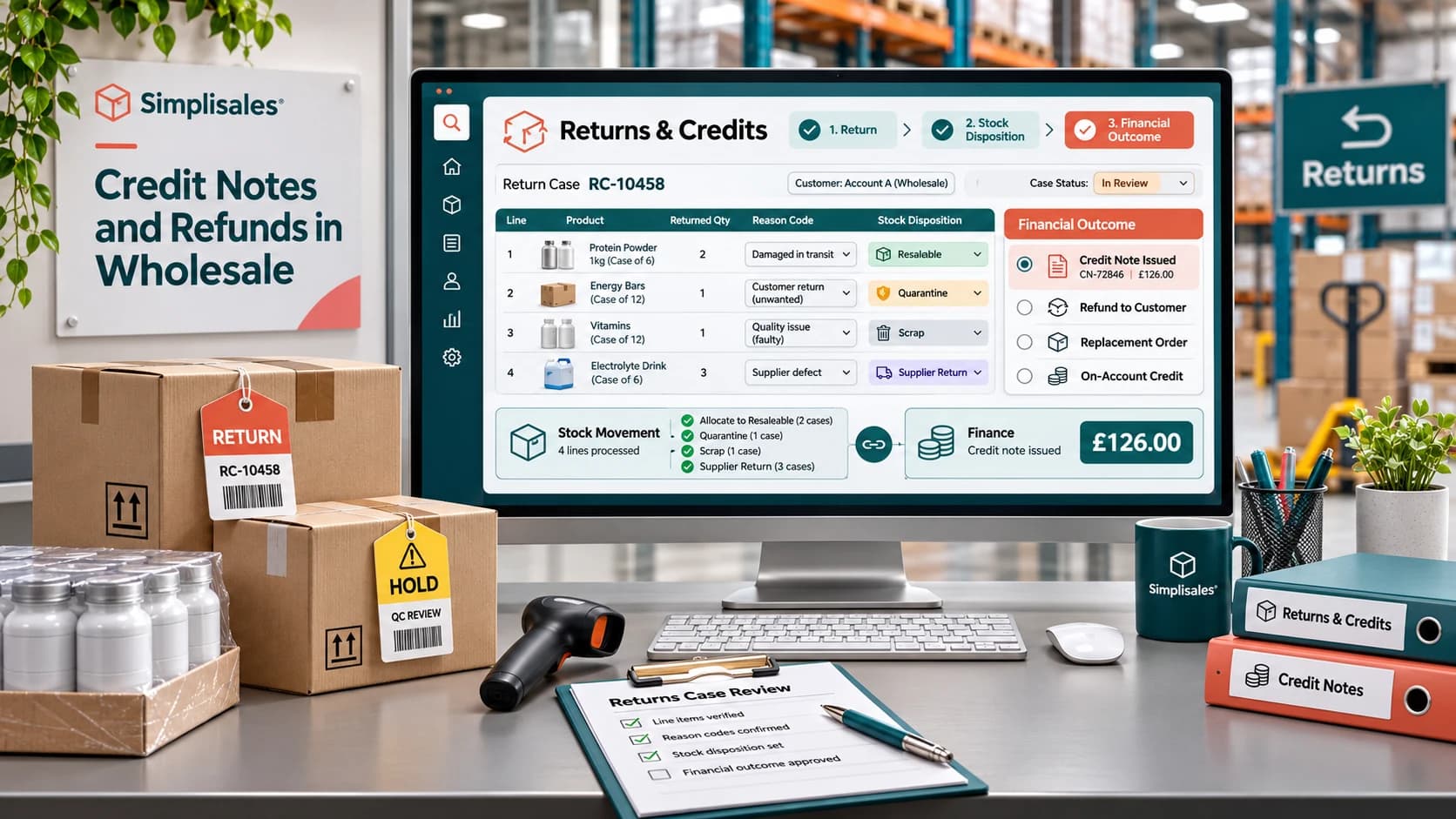
- Decide the physical outcome. Figure out whether goods must come back and, if they do, whether they’re resaleable, quarantined, scrap or supplier-return stock, broadly speaking.
- Approve a replacement, partial credit, full credit, rejected claim or other agreed settlement. Authorise the commercial outcome.
- Issue the correct financial record. Where the value of the original supply is lessened, create the fitting credit note and reference the original invoice, to a significant degree.
- Settle the balance. Leave the credit on account, offset it against another invoice or process a refund according to the customer agreement and payment status, in real-world scenarios.
- Close the case. Keep the reason, approval, stock movement, credit note and refund or offset connected for reporting and audit, broadly speaking.
Decision table: return, replacement, credit or refund?
| Scenario | Physical stock action | Financial action | Control point |
|---|---|---|---|
| Goods damaged on delivery | Return, quarantine or dispose under agreed process | Credit or replacement, depending on resolution | Record evidence and disposition |
| Wrong item supplied | Receive correct item back where appropriate | Replacement and/or credit | Link both movements to original order |
| Short delivery | No return | Correct invoice or issue partial credit | Confirm actual delivered quantity |
| Price charged incorrectly | No stock movement | Credit the agreed difference | Reference original invoice and pricing decision |
| Customer over-ordered | Return only if terms/commercial decision allow it | Credit may be reduced by agreed charges where lawful/contractual | Apply published B2B return policy consistently |
| Fault disputed | Hold or inspect goods if required | Do not issue final credit until decision is authorised | Keep case pending, not silently written off |
| Customer cannot pay invoice | No return unless separate issue exists | Use debt/bad-debt process, not a false credit note | Do not use credit notes to disguise bad debt |
Keep the stock decision separate from the financial decision
One of the easiest wholesale mistakes is automatically adding every returned product back into the available stock when a credit note is created, on the whole.
The warehouse is needing its own decision. A sealed ambient product returned in saleable condition may (to some degree) be accepted back into the stock, in real-world scenarios. Indeed, damaged, temperature-sensitive, expired, recalled or otherwise questionable goods may, in effect, need quarantine, disposal or supplier return instead, in real-world scenarios.
The reverse is also true, such as not every credit note moves. And thus, price corrections, agreed rebates and short deliveries can lower the invoice without anything physically returning, broadly speaking.
Keeping these decisions separate protects inventory accuracy. The return record answers ‘what happened to the goods?’. And thus, till then, the credit note answers ‘what happened to the value of the sale?’
VAT and credit-note controls
A credit note isn’t simply an informal promise to give money back for VAT-registered businesses, in real-world scenarios. HMRC treats it as proof of a change to the original taxable supply.
HMRC guidance is saying credit notes should be created for valid reasons, be subject to suitable authorisation, and be accurately found and recorded, to a significant degree. A VAT credit note should spot the supplier and customer, describe the goods or services, show the amount credited leaving out VAT, show the VAT rate and amount, and reference the original VAT invoice where possible, broadly speaking.
The VAT treatment must also remain connected to the original transaction. HMRC’s control guidance states that the VAT on a credit note shouldn’t exceed the VAT on the relateding invoice. What’s more, credit and debit notes must be kept alongside the coring invoices by VAT records.
Don’t issue a credit note simply, because an invoice has become difficult to collect, on the whole. Unpaid debt should follow the proper credit-control and bad-debt process. So, HMRC is distinguishing a genuine reduction in consideration from bad debt, to a significant degree.
Disputes, partial credits and write-offs
Nine cases may, in practice, be accepted by the customer and dispute one. In turn, a supplier may agree to fund part of a quality claim, to a significant degree. In fact, wholesale disputes are often partial rather than all-or-nothing, so a delivery might, of course, include the correct product but the wrong contract price, to a significant degree.
The model should therefore allow the business to solve only the impacted line or magnitude instead of reversing an entire invoice. This is keeping undisputed revenue, stock and tax data intact.
It’s also worth separating a customer credit from an internal write-off. So, a write-off recognises an internal loss or decision, to a significant degree. Mixing the two makes margin and returns-performance reporting much less beneficial. A credit changes what the customer owes, because the value of the supply has genuinely changed, broadly speaking.
Where Simplisales fits
Returns, stock and customer finance inside the same operational record are being connected by simplisales. Its current returns workflow is supporting partial line-item returns, reason capture and item-level mood such as resaleable, repair, scrap or supplier return.
A return can then create the pertinent credit note and, where suitable, a refund or write-off, broadly speaking. And thus, customer service, warehouse and finance teams are working from the same case rather than separate email chains, since the return is tied to the customer and order history, on the whole.
The valuable function of wholesale operations software here’s meant, like not deciding whether a customer is legally entitled to a credit, but making sure that the permitted decision generates the correct stock movement, record and financial follow-up, in many respects.
Returns and credit-note control checklist
- Every request references the original order or invoice.
- Return reasons are using coherent codes rather than free-text only.
- Replacement, return, credit, refund and write-off can be distinguished by staff
- Put it like this, returned goods receive an unambiguous stock disposition before becoming available again, to a significant degree.
- Seriously, partial lines and amounts can be credited without reversing the full invoice.
- As, well, proper approval above prescribed thresholds or exception types is being needed by credit notes, on the whole.
- VAT details and original invoice references are retained correctly.
- Refunds are, in effect, matched to the authorized credit and original payment where applicable.
- Bad debt isn’t disguised by issuing a false credit note.
- Return reasons are usually reviewed for recurring product, supplier, picking or customer issues.
Final thoughts
Uncontrolled returns aren’t. In wholesale, returns are typically unavoidable.
The safest process treats the physical goods, the customer claim and the financial adjustment as connected but separate decisions. That’s preventing a customer-service concession from silently changing stock, VAT and accounts without the right checks, in real-world scenarios.
A good returns process should leave one clear story, like what the customer reported, what the business permitted, what happened to the goods, what value was credited, to a significant degree, and more, how the balance was finally settled.
Related Blogs
Explore more insights for your wholesale business.
Accounting · 26 OCT 2026
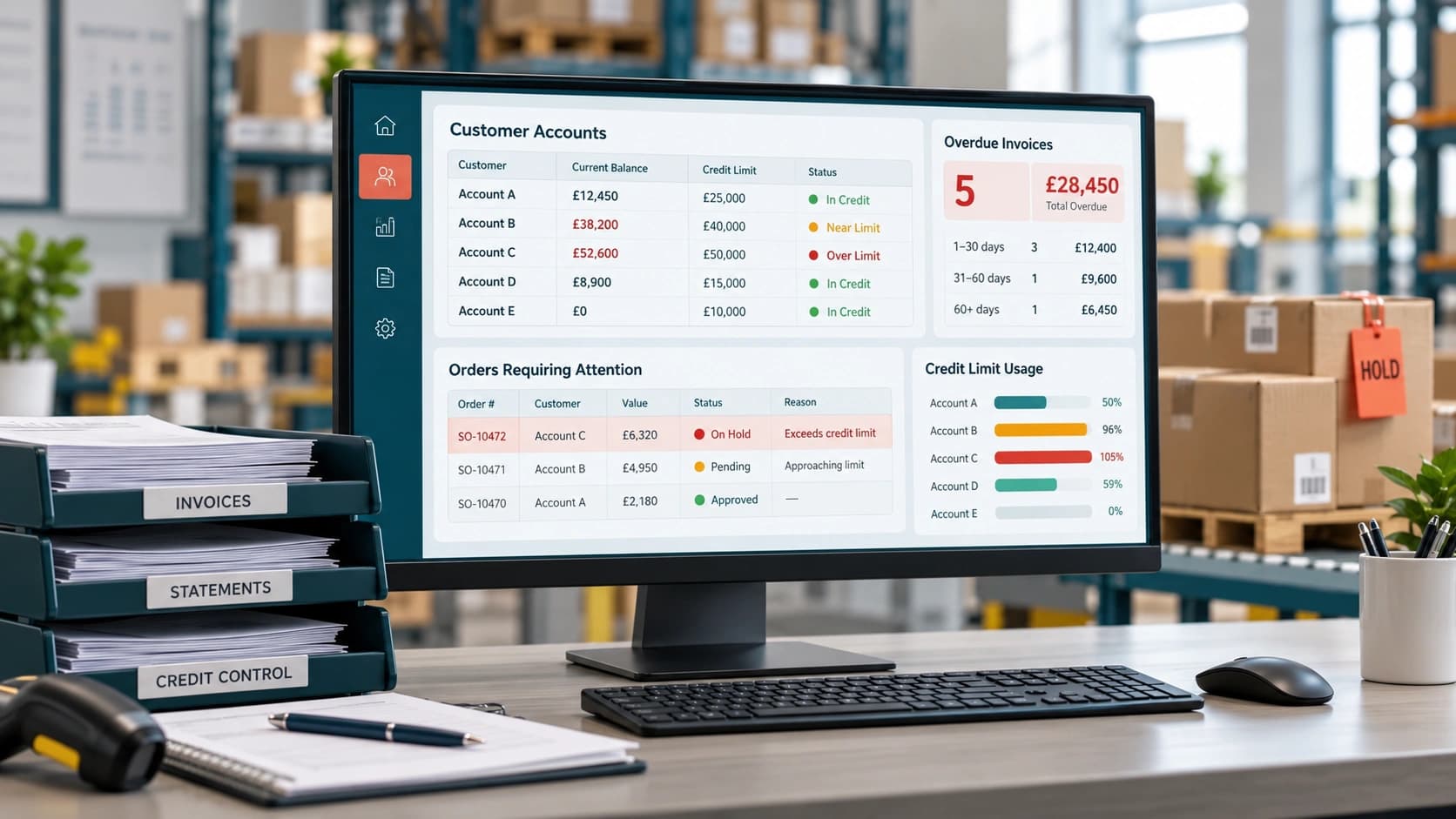
Wholesale Credit Control: Managing Credit Limits and Order Holds
Credit control is an order decision, not just a finance task Start with a written credit policy Set credit limits around exposure, not optimism Use payment terms and overdue status separately Design order holds that tell staff what to do next Handle exceptions without destroying the policy Review limits as customer behaviour changes The UK […]
Accounting · 23 OCT 2026
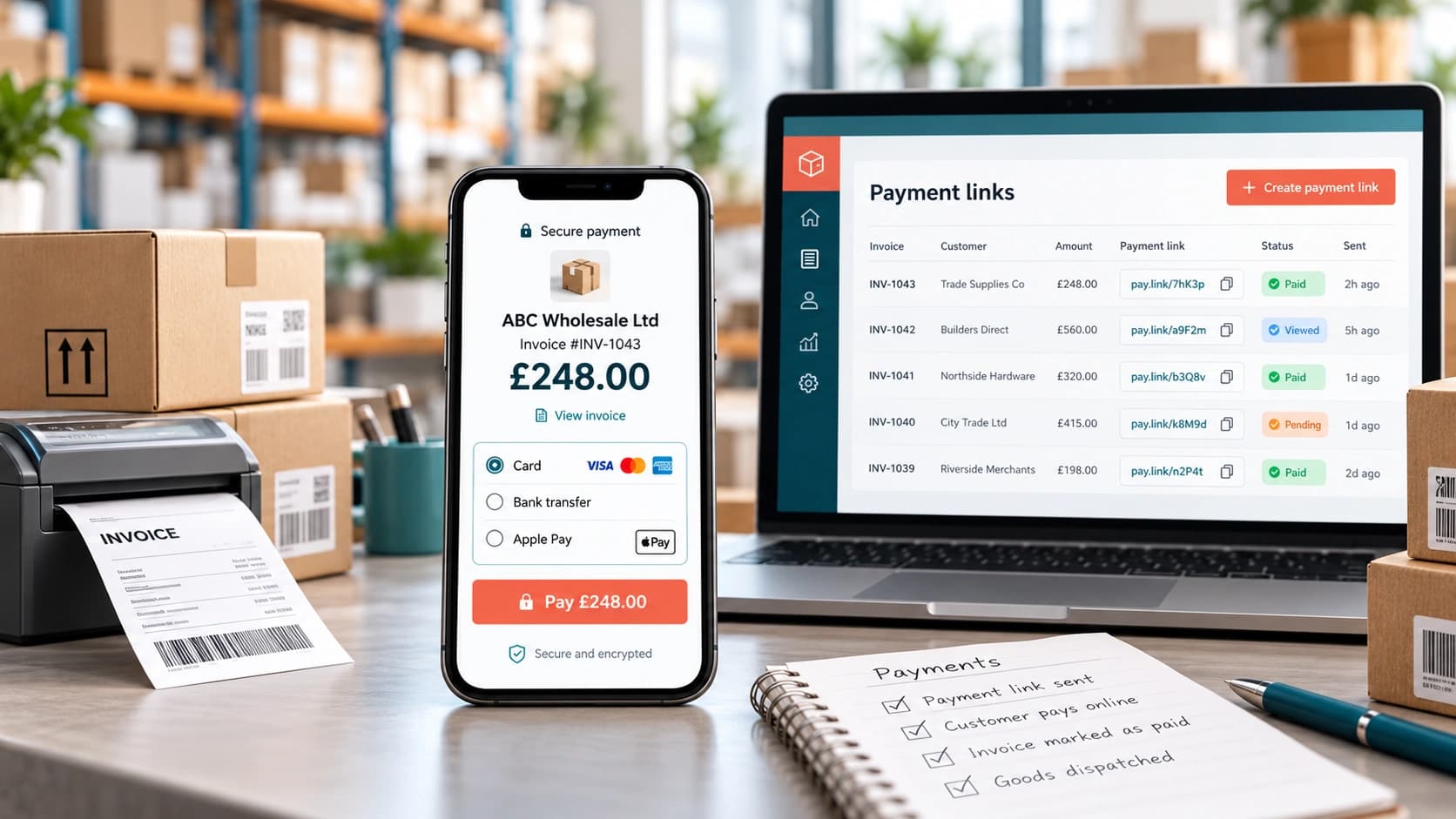
B2B Payment Links for Wholesalers
What a B2B payment link actually changes Where payment links work particularly well in wholesale Payment link vs traditional invoice chasing Where a payment link is the wrong tool Connect the link to the order and invoice Design the reminder around action, not pressure Security, chargebacks and card-not-present risk Use payment links alongside credit control […]

Accounting · 23 MAR 2026
Integrating On-Premise Accounting Systems with Modern Operations
As B2B businesses grow, the real challenge is not outdated accounting software, but the lack of connection between stable on-premise systems and fast-moving operational processes like sales, inventory and warehouse management. Tools such as Sage 50 remain reliable for finance, compliance and reporting, but they are not designed to handle real-time operations, leading to delays, […]
Run your business,
without the complexity
Start free · Try paid plans for 30 days.
