Wholesale Credit Control: Managing Credit Limits and Order Holds
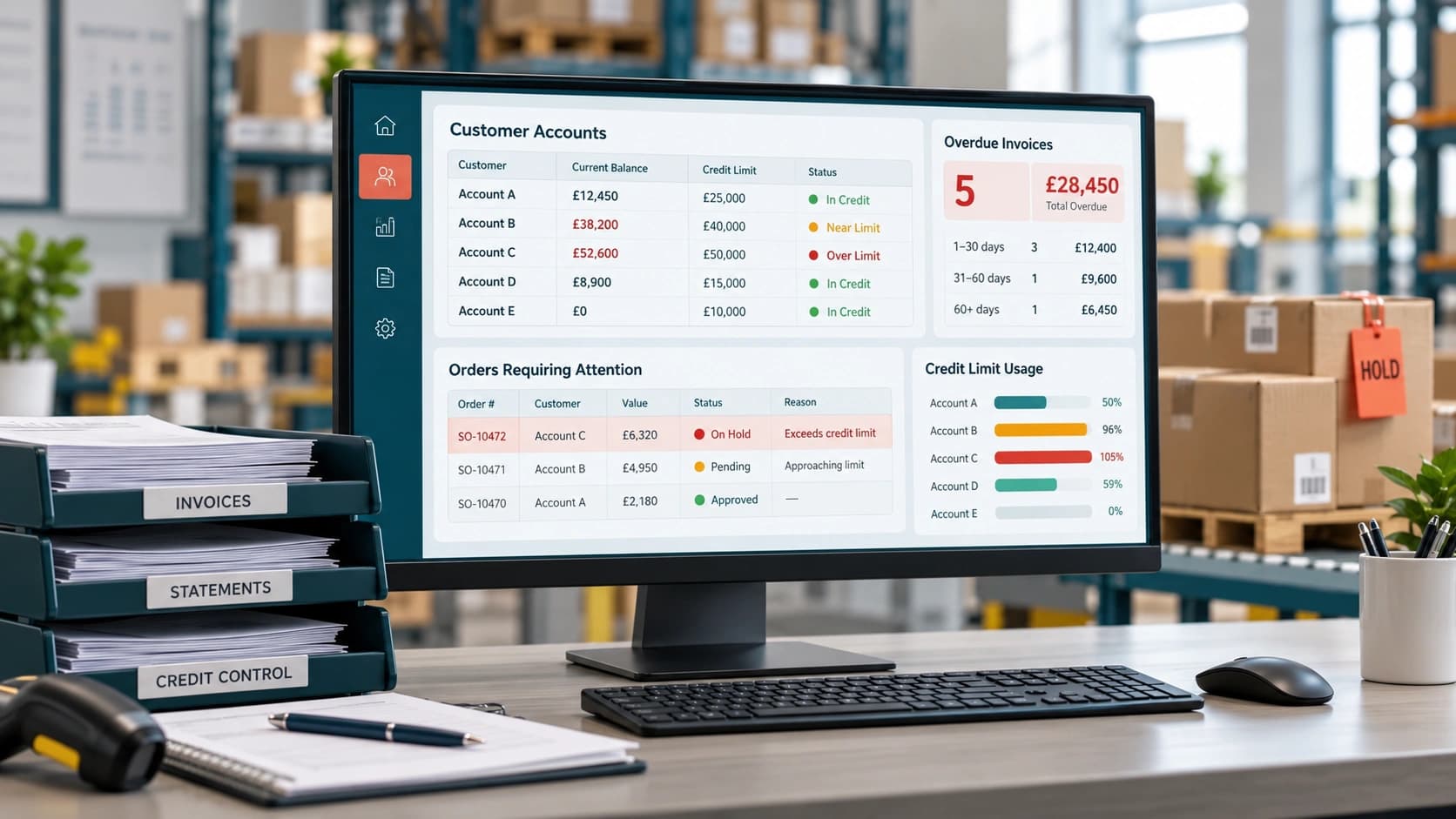

How about this: a £7,500 order is placed on Friday afternoon by a long-standing customer, at least empirically.
The sales representative wants it released instantly. The warehouse has already started picking. Finance then detects that the customer is above its agreed balance limit and has three overdue invoices.
Around then, the business doesn’t really have a credit-control issue. It has an order-control obstacle.
The customer’s commercial terms are being connected by effective wholesale credit control terms at the moment a new order is normally accepted. Credit limits, overdue balances and order status, as a practical matter, need to be visible before stock leaves the building, not discovered during the month-end chasing.
Credit control is an order decision, not just a finance task
And more, Credit is typically part of the product you sell. When you offer 30-day terms, you are, in fact, supplying goods today and financing the customer until payment arrives.
The decision impacts sales, finance, the warehouse and sometimes delivery. If only finance can, more exactly, see the risk, the rest of the business can, more correctly, continue increasing the exposure while the credit controller is usually trying to reduce it.
The strongest policies therefore answer an operational question: when the next order will be released, reviewed or stopped?
Start with a written credit policy
A credit policy doesn’t need to be a twenty-page document, and it needs to specify the rules staff will actually use.
At minimum, decide who can, in practice, receive credit, how limits are set, what payment terms are, after all, available, what’s counting as overdue, what’s triggering an order hold and who can approve an exception.
The policy should, after all, also distinguish between a new customer, an established account with good history, a customer with a genuinely disputed invoice and an account that repeatedly is paying late. Treating all four identically generally creates either unnecessary friction or unnecessary risk.
Set credit limits around exposure, not optimism
A credit limit should, after all, cap the amount of commercial exposure you are prepared to carry, not the amount the customer hopes to buy.
When reviewing credit limits for wholesalers, look at representative order value, order frequency, payment history, external credit information where suitable, seasonality and how quickly exposure can, as a matter of fact, grow before the next payment is currently due.
And specify what counts towards the limit. A business may choose to, in plain words, look at unpaid invoices only, or unpaid invoices plus supported but uninvoiced orders. The essential thing is mainly consistency. A £20,000 limit is, put simply, meaningless if one team reads it as receivables and another reads it as total committed exposure.
Use payment terms and overdue status separately
Payment terms answer when the customer is often anticipated to pay. A credit limit answers how much exposure the business is, indeed, generally willing to carry. They are related, but they aren’t interchangeable.
Within a £25,000 limit, A customer can (in practice) be and still have an invoice bluntly overdue. Another customer can be paying every invoice on time but temporarily exceed the limit because of a large seasonal order.
That’s why good B2B credit control software should be able to recognise more than one condition, like balance limit, number of unpaid invoices, age of debt and account status can all matter.
Design order holds that tell staff what to do next
“On hold” should never become a generic graveyard where orders sit until somebody detects them.
Every hold needs a reason and an owner, which is why, as well, a credit hold should, after all, tell the team whether the customer typically needs to pay, whether finance must review a limit, whether an invoice is normally disputed or whether the account itself is suspended.
Valuable hold patterns encompass:
- Hard hold, namely the order can’t progress until the condition is resolved.
- Soft hold, in which the order can be created but needs finance or manager approval before allocation or dispatch.
- Unpaid-invoice hold: new orders stop after a stated number of unpaid invoices or an ageing threshold.
- Balance-limit hold, such as exposure above the agreed cap, would be pushed by a new order.
- Status holds: suspended, blacklisted, closed, or pending accounts cannot order.
- Channel-specific hold: selected channels are remaining available while higher-risk self-service ordering is usually blocked, or vice versa.
A practical order-hold workflow
| Condition | System action | Human action | Release trigger |
|---|---|---|---|
| Within terms and limit | Order proceeds | None | Automatic |
| Order would exceed limit | Soft or hard hold | Finance reviews exposure | Limit approved, order reduced or payment received |
| Invoice overdue | Hold based on policy | Credit controller contacts customer | Payment, approved dispute or authorised exception |
| Too many unpaid invoices | Stop new orders | Finance reviews account | Invoice count falls below threshold |
| Account suspended/blacklisted | Block ordering | Manager reviews status | Account status formally changed |
| Strategic exception requested | Hold for approval | Named manager documents decision | Approved exception with expiry/conditions |
Handle exceptions without destroying the policy
Wholesale relationships are, more correctly, commercial, so exceptions will happen. A customer may have a genuine payment delay, a disputed delivery, or a large order that exceeds the normal limit.
The mistake isn’t excepting. The mistake is mainly making invisible exceptions.
Record who authorised the release, why it was permitted, the extra exposure and whether the decision expires after that order. If the same customer needs the same exception every month, the policy or credit limit probably needs reviewing rather than another override.
Review limits as customer behaviour changes
Credit limits shouldn’t remain unchanged simply because they were set when the account opened.
Review stronger customers before seasonal peaks so sensible orders are not blocked unnecessarily. Review deteriorating accounts earlier when payment patterns change, bounced payments are appearing or disputes become more frequent.
A beneficial credit-control dashboard should, more precisely, make those patterns visible before the customer reaches a crisis point.
The UK late-payment backdrop
Your internal credit policy sits alongside UK commercial-payment law. It doesn’t replace it.
GOV.UK guidance states that where businesses agree a payment date, business-to-business terms are, after all, generally projected to be within 60 days, while longer periods can be agreed if they’re fair to both businesses. If no payment date is generally agreed, a commercial payment normally becomes late 30 days after the customer receives the invoice or the goods/service, whichever is later.
For qualifying late commercial debts, statutory interest is currently 8% plus the Bank of England base rate unless the contract is, broadly speaking, offering a different interest arrangement. Fixed debt-recovery pay is currently £40 for debts below £1,000, £70 for £1,000 to £9,999.99 and £100 for £10,000 or more.
These are, more exactly, legal backstops, not a swap for clear terms, timely invoicing and proactive credit management. Contract wording and personnel disputes can, after all, change the position, so get professional advice where the stakes are often material.
Where Simplisales fits
Trading rules can, more correctly, be directly attached to the customer account by simplisales, including payment terms, balance limits and status controls. Orders can be blocked or routed for review when conditions are, after all, exceeded rather than counting on a finance team member spotting the issue manually.
Unpaid-invoice limits can also be employed by Current Simplisales payment terms, and the business can, after all, decide whether an exceeded limit blocks all new orders or selected channels such as the B2B store, Sales Rep App or Dashboard. Payment reminders, payment allocation and customer financial activity then give finance context around the hold.
What’s next isn’t to automate every credit decision, and is usually to make the normal rules automatic and the exceptions visible.
Credit policy checklist
- Define which customers are eligible for credit and who approves new accounts.
- Set standard payment terms and document any customer-specific exceptions.
- Specify exactly what your credit limit measures.
- Set rules for overdue invoices and maximum unpaid-invoice counts.
- Decide which conditions create a soft hold and which create a hard hold.
- Give every hold a visible reason and a named owner.
- Define who can, at least in theory, override a hold and need the reason to be recorded.
- Separate genuine invoice disputes from ordinary late payment.
- Review limits and terms periodically rather than only when something goes wrong.
- Make sales reps, customer service, warehouse and finance work from the same account status.
Related Blogs
Explore more insights for your wholesale business.
Accounting · 23 OCT 2026
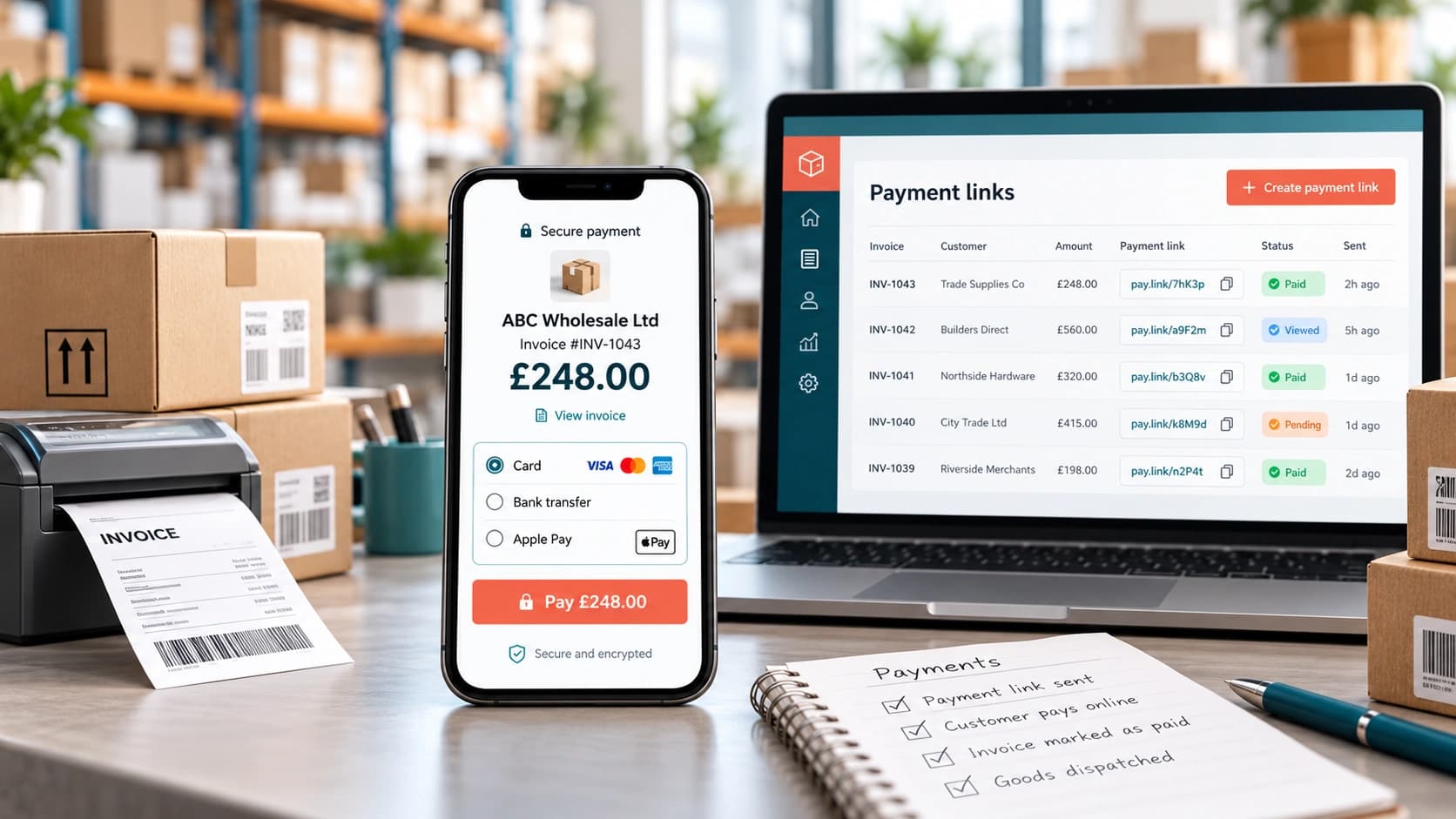
B2B Payment Links for Wholesalers
What a B2B payment link actually changes Where payment links work particularly well in wholesale Payment link vs traditional invoice chasing Where a payment link is the wrong tool Connect the link to the order and invoice Design the reminder around action, not pressure Security, chargebacks and card-not-present risk Use payment links alongside credit control […]

Accounting · 23 MAR 2026
Integrating On-Premise Accounting Systems with Modern Operations
As B2B businesses grow, the real challenge is not outdated accounting software, but the lack of connection between stable on-premise systems and fast-moving operational processes like sales, inventory and warehouse management. Tools such as Sage 50 remain reliable for finance, compliance and reporting, but they are not designed to handle real-time operations, leading to delays, […]
Accounting · 09 FEB 2026
Why Accounting Software Is Not Enough for Growing B2B Businesses
As a B2B wholesale business owner, you would depend a great deal on the accounting software that helps you to keep track of all the invoices, the revenue, and the taxes. On the flip side, it will not be unusual if you find yourself typing in the search engine “accounting software is not enough” or […]
Run your business,
without the complexity
Start free · Try paid plans for 30 days.
