B2B Pricing: SaaS Fees, Add-Ons and Total Cost of Ownership
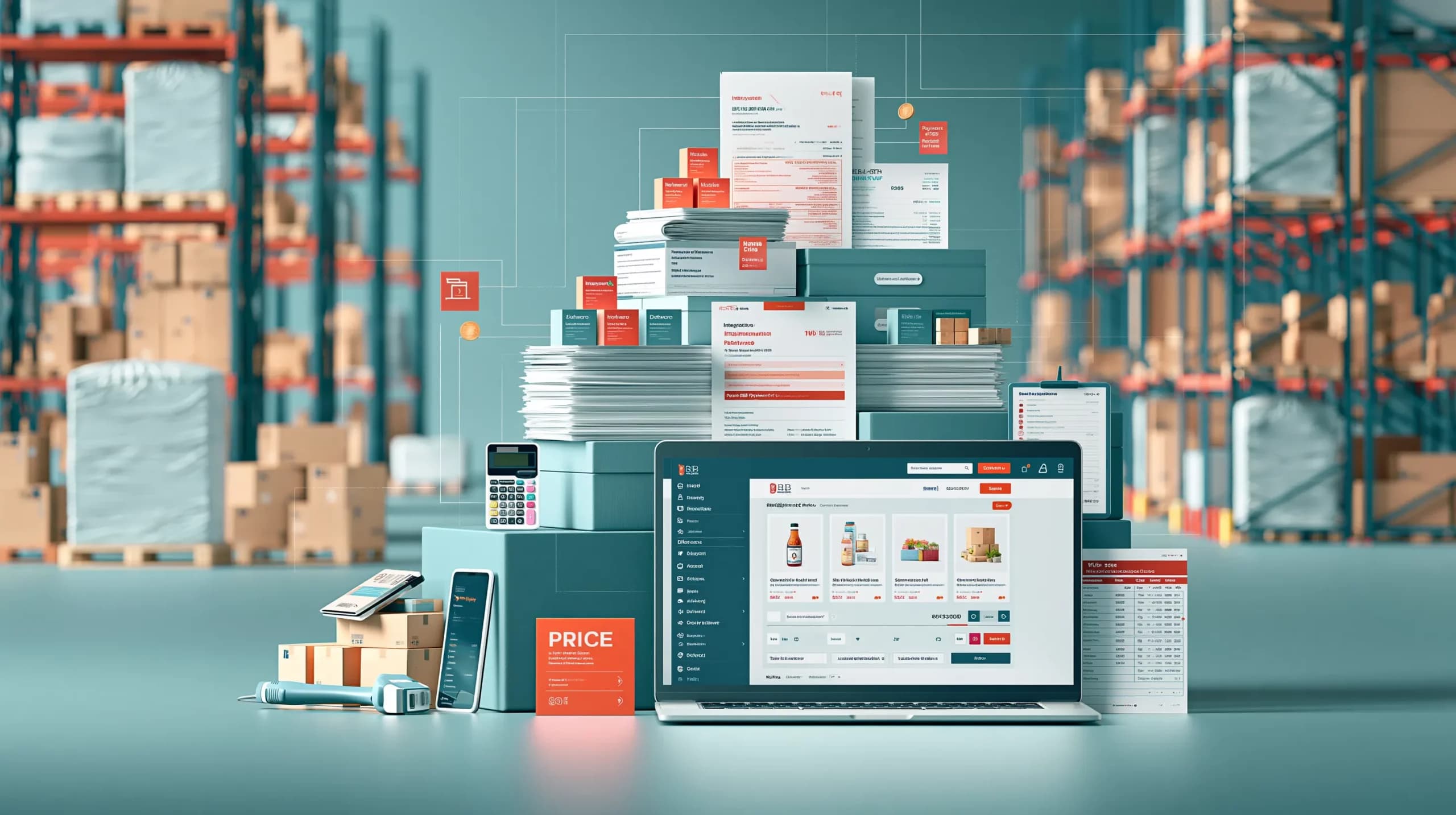

A wholesaler compares two B2B ecommerce platforms.
- Platform A costs £300 per month.
- Platform B costs £1,000.
The decision looks obvious.
Then implementation begins.
Platform A needs an ERP connector, a wholesale pricing app, sales-representative software and another tool for warehouse operations. The website also requires development work before customers can actually use it.
Six months later, the cheaper platform is no longer cheaper.
This is why finding the best B2B ecommerce platform for wholesalers requires more than comparing monthly subscriptions.
You need to understand how the platform charges as your business grows, which features are included, what requires additional software and what the entire system will cost to operate.
That is the difference between subscription price and total cost of ownership.
The Monthly Subscription Is Only the Starting Point
B2B ecommerce software is commonly sold using several pricing models.
Fixed SaaS Subscription
You pay a monthly or annual fee for a defined package.
This is usually the easiest model to budget because costs remain relatively predictable until you change plans.
However, check what happens when you add users, integrations, warehouses or advanced functionality.
Tier-Based Pricing
Your plan determines which features and limits are available.
Higher tiers may unlock additional users, catalogues, locations, automation, APIs or B2B functionality.
This looks straightforward until one requirement forces you onto a much more expensive tier.
GMV or Revenue-Based Pricing
Some platforms increase pricing according to Gross Merchandise Value (GMV) or online revenue.
This aligns cost with growth, but it also means your ecommerce bill can increase even when your technical requirements have not changed.
For wholesalers processing large-value orders, GMV pricing deserves particular attention.
Modular or Add-On Pricing
The core platform has one fee, while additional modules are charged separately.
Examples might include:
- B2B ecommerce
- Mobile ordering
- Sales-representative apps
- Warehouse management
- Route planning
- AI ordering
- Advanced inventory
- Additional integrations
This approach can be attractive because you only pay for what you need.
But you must calculate the price of the actual configuration you will operate, not the cheapest base plan.
Enterprise Quote-Based Pricing
Enterprise platforms often do not publish a standard price.
Instead, pricing may depend on GMV, internal users, regions, hosting architecture, storefronts, integrations or contractual requirements.
Adobe Commerce, Sana Commerce and OroCommerce all currently use some form of customised pricing for their enterprise offerings.
For a larger business, this is normal.
It simply makes direct price comparison more difficult.
How Current B2B eCommerce Pricing Models Compare
Published prices change frequently, but the current market illustrates how different the models can be.
| Platform | Published Entry Point | Pricing Model | Important Cost Considerations |
| Shopify | From $39/month monthly | Tiered SaaS | B2B now available across plans; advanced functionality varies by tier |
| Shopify Plus | From $2,300/month on eligible long-term pricing | Enterprise SaaS | Unlimited B2B catalogues and broader enterprise capabilities |
| BigCommerce | From $39/month | SaaS + GMV thresholds | Plan upgrades, GMV overage and payment-provider fees can affect cost |
| BigCommerce Performance | From $1,499/month | Enterprise / volume-based | Contracted pricing for high-volume businesses |
| Simplisales | Free; paid plans from $140/month | Modular wholesale SaaS | Ecommerce, stock, AI, field sales and delivery modules vary by plan/add-on |
| Sana Commerce Cloud | Request pricing | Enterprise SaaS | Pricing based on requirements and ERP environment |
| OroCommerce | Request pricing | GMV + users + deployment | Licence influenced primarily by GMV, admin users and hosting model |
| Adobe Commerce | Request pricing | Enterprise SaaS/PaaS | Implementation, infrastructure and development can materially affect TCO |
Prices above are published platform prices checked in August 2026 and exclude tax, implementation and other costs unless the provider states otherwise.
The table also demonstrates why searching for the best wholesale ecommerce platform purely by monthly price can be misleading.
Two platforms charging similar subscriptions may include completely different capabilities.
Shopify: Low Entry Cost Does Not Mean You Need Shopify Plus
One important change in 2026 is Shopify’s B2B pricing model.
Historically, businesses often associated native Shopify B2B with Shopify Plus.
That is no longer entirely true.
Shopify has extended foundational B2B features across Basic, Grow and Advanced plans without a separate B2B fee.
Those plans can support features such as company profiles, custom catalogues, pricing, quantity rules and payment terms.
There are still limits.
Basic, Grow and Advanced currently support up to three active B2B catalogues across B2B markets, while Plus offers unlimited catalogues and more advanced assignment and enterprise functionality.
For a smaller wholesaler, that makes Shopify considerably more accessible than it once was.
For a wholesaler with hundreds of individual price structures, complex account hierarchies or substantial enterprise requirements, the practical cost may still move towards Plus or additional systems.
BigCommerce: Watch GMV and Payment Costs
BigCommerce illustrates another pricing model.
Its current self-service plans begin relatively cheaply, but tiers are linked to sales volume.
The Scale plan also applies an overage model above its GMV threshold.
Following BigCommerce’s June 2026 pricing update, merchants using certain Open Payment Providers on self-service plans can also face an additional fee calculated against eligible order GMV.
That means the platform subscription alone may not tell you what a high-volume wholesaler will actually pay.
When comparing platforms, model your expected annual B2B sales rather than evaluating today’s turnover.
A platform that looks inexpensive at £500,000 of ecommerce revenue may behave very differently at £5 million.
Add-Ons Can Change the Comparison Completely
Suppose a platform costs £300 per month.
Then you discover that you also need:
- £300 per month of additional apps
- £500 per month for ERP connectivity
- £8,000 of implementation work
Your first-year cost is no longer £3,600.
It is £21,200 before payment processing and internal labour.
That example is hypothetical, but the principle matters.
When evaluating B2B ecommerce software, ask whether the following are native, paid add-ons or separate third-party products:
| Capability | Why It Can Affect TCO |
| ERP/accounting integration | Connector licences and implementation |
| Customer-specific pricing | May require higher tier or extension |
| Mobile B2B ordering | Separate app/module on some platforms |
| Sales-rep ordering | Additional seats or software |
| Multi-warehouse inventory | May require WMS/inventory platform |
| Purchasing | Often outside ecommerce |
| Picking and packing | Usually external on commerce-first platforms |
| Delivery routing | Usually specialist software |
| Search and merchandising | Enterprise add-ons may apply |
| API access | Sometimes restricted by plan |
| Additional storefronts | Can increase licences or implementation |
| Support/onboarding | May be standard, premium or partner-delivered |
The cheapest platform can still be the right platform.
You simply need to compare complete architectures rather than licence fees.
Calculate Total Cost of Ownership
A useful three-year TCO calculation should include:
**Platform subscription
- paid modules/apps
- implementation
- integrations
- design/development
- payment or GMV fees
- hosting/infrastructure where applicable
- ongoing maintenance
- support
- internal administration**
Internal administration is frequently ignored.
Imagine your ecommerce system does not synchronise customer pricing properly.
Someone may spend ten hours each week maintaining price lists.
That labour is part of the cost of the platform even though it never appears on a software invoice.
The same applies to manually re-entering orders, correcting inventory, exporting spreadsheets or resolving integration failures.
The Best Platform Depends on What You Already Have
There is no universal best B2B ecommerce platform for wholesalers.
A wholesaler with SAP, an established WMS and an internal development team may prioritise a sophisticated customer-facing commerce engine.
Adobe Commerce, OroCommerce or another enterprise platform could make sense because the surrounding operational infrastructure already exists.
Another distributor may currently operate with Sage, spreadsheets, email orders and a warehouse team.
That business may receive more value from software that combines customer ordering with inventory, purchasing, warehouse and sales-representative workflows.
The question is therefore not:
“Which platform has the most features?”
Ask instead:
“Which systems will we still need after buying it?”
Where Simplisales Fits
Simplisales uses a modular wholesale-first pricing approach.
The current structure begins with a free plan, followed by Essential at $140 per month, Professional at $700 per month and custom Enterprise pricing.
Rather than focusing only on storefront ecommerce, the platform can extend into purchasing, AI order capture, multiple warehouses, advanced stock management, field sales, route planning and B2B ordering.
Some capabilities are included at higher tiers while others can be added separately.
For example, the current pricing structure lists modules for B2B ecommerce, advanced stock management, field sales and route planning alongside the core Simplisales Dashboard.
This can change the TCO calculation for a wholesaler.
If you already have strong purchasing, warehouse and field-sales systems, you may not need those capabilities.
If you currently pay for several disconnected tools, bringing more operations into one wholesale platform could reduce integration and administration costs.
The right comparison is therefore not:
“Simplisales monthly fee vs ecommerce platform monthly fee.”
It is:
“What does our complete wholesale technology stack cost under each option?”
B2B eCommerce Pricing Checklist
Before signing a contract, confirm:
- Monthly and annual platform fees
- Contract length and renewal terms
- GMV or revenue thresholds
- Transaction or payment-provider fees
- User and administrator limits
- Number of B2B catalogues or price lists
- Product/SKU limits
- ERP or accounting integration costs
- API availability and limits
- Mobile ordering costs
- Sales-representative access
- Inventory and warehouse functionality
- Implementation and data migration
- Third-party app subscriptions
- Support and onboarding costs
- Development and maintenance requirements
- Expected cost at 2x and 5x your current online revenue
If a supplier cannot clearly explain how your cost changes as you grow, treat that as part of the purchasing decision.
Final Thoughts
B2B ecommerce pricing is rarely as simple as £X per month.
Modern platforms can charge through subscriptions, tiers, GMV thresholds, users, modules, payment fees or customised enterprise contracts.
That does not make any pricing model inherently bad.
A £2,000 platform that replaces four systems may be better value than a £300 platform requiring thousands of pounds in apps, integrations and manual administration.
Likewise, a growing wholesaler does not automatically need an enterprise platform simply because it offers more functionality.
When searching for the best wholesale ecommerce platform, calculate what you actually need today, which systems the platform will replace or connect with, and what the architecture will cost as your business grows.
The best B2B ecommerce platform for wholesalers is not necessarily the one with the lowest subscription.
It is the one with the most sustainable total cost of ownership for the operation you actually run.
Related Blogs
Explore more insights for your wholesale business.
Wholesaling · 27 JUL 2026
How to Become a Tobacco Wholesaler in the UK
This blog post explains that becoming a tobacco wholesaler in the UK requires more than registering a company, as businesses involved in manufacturing, importing, storing, transporting, or selling tobacco must comply with the Tobacco Track and Trace system. Wholesalers need an Economic Operator ID for the business, a Facility ID for each relevant premises, and […]

Wholesaling · 20 JUL 2026
How to Become an Alcohol Wholesaler in the UK
Starting an alcohol wholesale business in the UK involves more than registering a company, as most businesses selling alcohol to other businesses must obtain approval under HMRC’s Alcohol Wholesaler Registration Scheme (AWRS) before trading. The guide explains who needs AWRS approval, how and when to apply, what HMRC’s fit and proper assessment involves, and the […]

Wholesaling · 10 JUL 2026
Starting a Food Wholesale Business in the UK: Registration, Food Safety and Legal Requirements
Establishing a wholesale food business in the UK goes beyond getting set up as a company. Food safety and regulatory responsibilities must be met before trading starts. For the majority of food wholesalers, getting registered by completing a free Food Business Registration form with the local authority is all that is needed, but those wholesalers […]
Run your business,
without the complexity
Start free · Try paid plans for 30 days.
