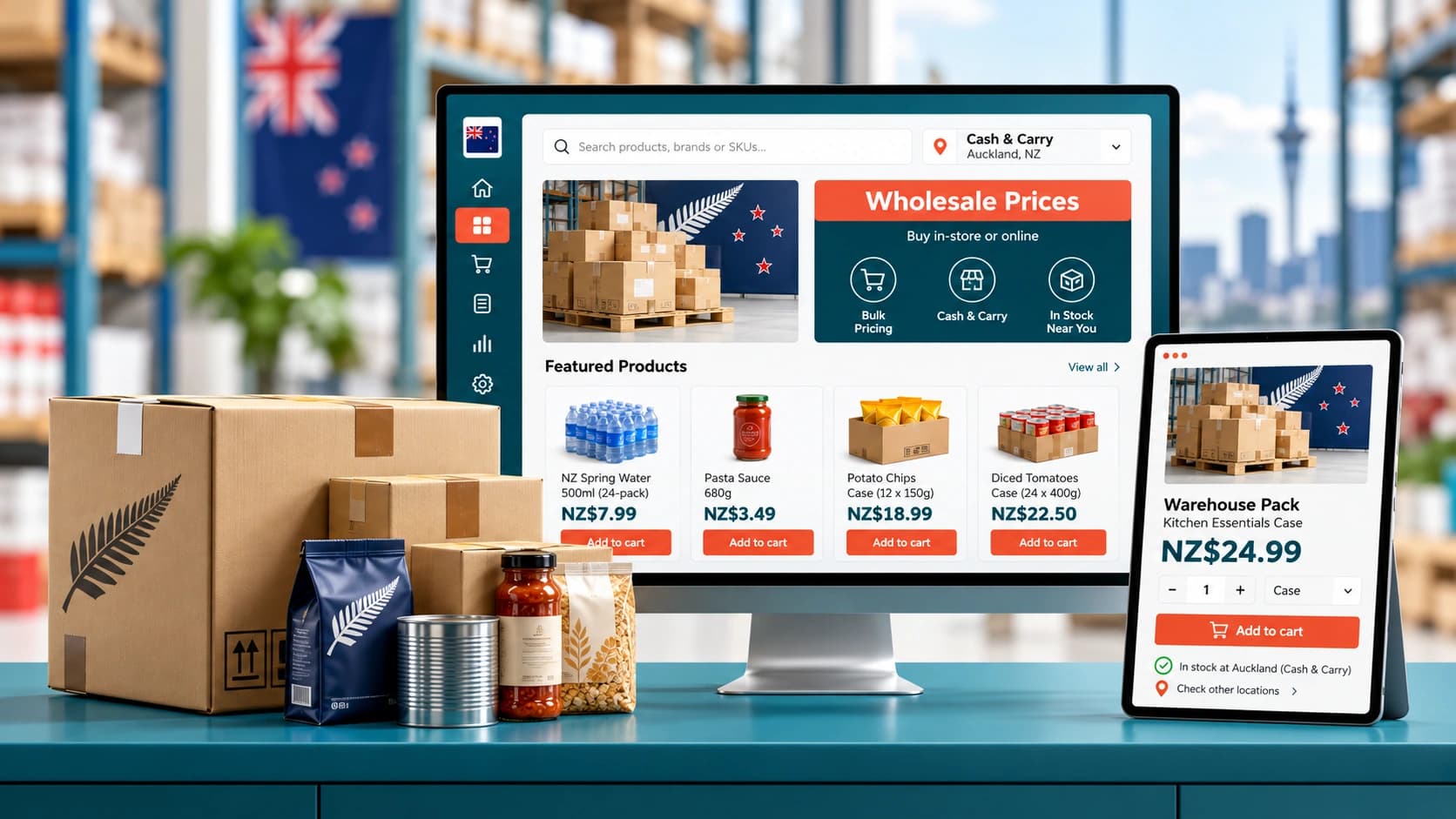

New Zealand does not need to be persuaded that cash and carry works. The model is already visible in mainstream trade foodservice: Gilmours explicitly offers customers the choice between shopping in a Cash and Carry store and having an order picked, packed and delivered.
That makes New Zealand different from a market where the concept itself needs explaining. The more useful question is: where can a new operator improve on the established model?
The answer is likely to be in customer experience and operational flexibility – smaller business accounts, faster digital ordering, better visibility of stock, easier collection and more precise delivery options – rather than simply building another warehouse full of bulk packs.
Cash and Carry Is Already a Familiar Model in New Zealand
New Zealand is compact enough for depot-and-delivery networks to work well, but still too spread out for a walk-in-only model. Existing foodservice wholesalers already combine distribution points, online ordering, collection and delivery, so a new entrant needs a reason to exist beyond ‘we sell big packs’ – for example a specialist range, sharper pickup pricing, regional service or better support for small independent customers.
Business Registration and GST
A company registered with the New Zealand Companies Office automatically receives a New Zealand Business Number (NZBN). Other business structures can also obtain an NZBN, which is useful for sharing business identity and invoicing details.
GST registration becomes compulsory when taxable turnover reaches, or is expected to reach, NZ$60,000 in a 12-month period, or if the business starts adding GST to its prices. New Zealand GST is 15%.
For a B2B wholesaler, this is operationally important because trade prices are often discussed excluding GST while invoices and accounting must apply it correctly. Product pricing, customer terms and online ordering should use one consistent tax logic from the start.
| Area | New Zealand position | Cash and carry implication |
| Business identity | NZBN; companies register with Companies Office | Use account verification for trade customers |
| GST | Mandatory from NZ$60,000 taxable turnover | Build 15% GST treatment into pricing/invoicing |
| Food distribution | Transporters/distributors generally fall under National Programme 1 | Registration, records and verification are part of the operating model |
| Imported food | Importer must register with MPI and have a Customs client code | Allow lead time before building imported ranges |
| Alcohol wholesale | Certain B2B wholesale sales are exempt under s8 of the Sale and Supply of Alcohol Act | Do not confuse wholesale-only sales with retail sales to the public |
| Tobacco/vaping | Relevant wholesalers/distributors must notify Ministry of Health | Regulated-category customer and product records matter |
Food Distribution: National Programme 1 Is the Key Starting Point
For a food-focused cash and carry, New Zealand’s Food Act framework is unusually useful because it explicitly classifies transporters or distributors of food under National Programme 1 (NP1), the lower-risk programme.
NP1 businesses must register, follow applicable food-safety rules, keep records and undergo verification by a recognised verifier. If the business operates within one local council area, registration is generally with that council. If it operates across more than one council area, it can register sites separately or use a single MPI registration where the rules allow.
For expansion, this matters: one depot and a multi-region network can have different registration routes. Activity matters too. A pure distributor may fit NP1, while processing, repacking or other food handling can move the operation into another National Programme or a Food Control Plan. MPI’s My Food Rules tool should be run against the real operating model.
Importing Food: Registration Is Separate
A food-business registration does not automatically make you a food importer.
All food, beverages and ingredients imported for sale in New Zealand must be imported by a registered food importer or through an agent that is registered. Commercial food importers also need a New Zealand Customs client code. MPI states that an unregistered importer’s consignment can be held at the border.
Importers remain responsible for safety, storage, transport, records and recalls. For a cash and carry built around imported grocery or specialist hospitality lines, the importer role should be designed before the first container is ordered.
Alcohol Has an Unusual Wholesale Exemption
New Zealand has a particularly important distinction for alcohol. Section 8 of the Sale and Supply of Alcohol Act 2012 exempts certain sales by makers, importers, distributors and wholesalers when alcohol is supplied in the course of that business to another maker/importer/distributor/wholesaler, a licence holder or a permanent club charter holder.
In practical terms, a genuine wholesale transaction to a licensed restaurant, bar or retailer is not treated in the same way as an ordinary retail sale to the public.
That does not permit unlicensed public retail. If the model includes consumer sales or other non-exempt supply, the off-licence regime becomes relevant. The account system therefore needs to distinguish qualifying trade buyers from ordinary consumers.
Tobacco and Vaping Require Notifications
New Zealand also has a specific notification regime for regulated smoking and vaping products. Distributors of smoked tobacco have been required since 1 October 2023 to notify the Director-General of Health that they sell smoked tobacco at wholesale. The notification is submitted through HARP and must be renewed annually.
Businesses selling vaping, smokeless tobacco or herbal smoking products also fall within the Regulated Product Seller notification system. Current Ministry of Health guidance lists an annual assessment fee of NZ$80 plus GST, excluding card fees. One regulated category can therefore create obligations that do not apply to the rest of the warehouse.
Where a New Cash and Carry Can Compete
New Zealand’s opportunity is less about national scale and more about being useful to a clearly defined trade community.
A depot near a dense hospitality or independent-retail catchment can offer low-friction collection. Digital ordering can remove the need to walk the warehouse for routine purchases. Delivery can serve customers outside the immediate area or buyers placing larger scheduled orders.
Because the market is smaller, range depth in a particular customer segment can be more defensible than trying to stock everything. The model also suits transparent service tiers: lowest price for self-pickup, standard delivery above a minimum order and more account-based service for higher-value customers.
Building the Right Hybrid Model
The branch should function as one fulfilment option rather than the entire business. Approved customers should be able to see their own pricing, build repeat orders, check stock, choose collection or delivery and maintain order history. Internally, the same stock should feed counter sales, ecommerce orders and sales-rep orders so that one channel does not promise inventory already committed elsewhere.
Food operators should keep supplier, lot/batch and customer records easy to retrieve, while import-heavy businesses should link product records to importer and supplier information.
In New Zealand, the strongest digital opportunity is to make an already-familiar Cash and Carry model easier to use. A hybrid operation works best when customer ordering, stock, pricing, collection and delivery are connected rather than run as separate channels. Simplisales Dashboard can manage customers, products, purchasing, inventory and warehouse activity, while the Simplisales Ecommerce Website and Simplisales Ecommerce App give trade buyers self-service ordering alongside branch, sales-rep and delivery workflows.
Final Thoughts
New Zealand is one of the clearest markets for a modern cash and carry concept because the model is already understood. The challenge is not education; it is differentiation.
For food businesses, the legal route is relatively structured: identify the correct Food Act programme, register with the appropriate council or MPI, arrange verification and register separately if you import food. Alcohol wholesale has a valuable B2B exemption, but that exemption should never be stretched into unlicensed retail. Tobacco and vaping introduce their own notification rules.
Commercially, the best opportunity is likely to come from combining trade-counter simplicity with digital convenience – a branch for immediacy, online ordering for repeat purchasing and delivery for customers whose time is worth more than the trip.
Official references and further reading
Business.govt.nz – Starting a company
Inland Revenue – Registering for GST
MPI – National programmes under the Food Act 2014
MPI – Steps for National Programme 1
MPI – Register a food business under the Food Act
MPI – Registering as a food importer
New Zealand Customs – Client codes
New Zealand Legislation – Sale and Supply of Alcohol Act 2012, section 8
Ministry of Health – Information for distributors of smoked tobacco products
Related Blogs
Explore more insights for your wholesale business.
Cash and Carry · 09 OCT 2026
Cash and Carry in Canada
Start With the Canadian Market, Not the British Label Business Registration and a Multi-Layer Tax System Food Wholesale: Federal Licensing Depends on What You Do Traceability Can Apply More Broadly Than Licensing Alcohol Is a Provincial Distribution Question Tobacco Rules Are Provincial Too Where the Cash and Carry Opportunity Is Strongest Design the Depot […]
Cash and Carry · 02 OCT 2026
Cash and Carry in Australia
In Britain, the phrase cash and carry immediately suggests a trade warehouse: […]
Run your business,
without the complexity
Start free · Try paid plans for 30 days.
