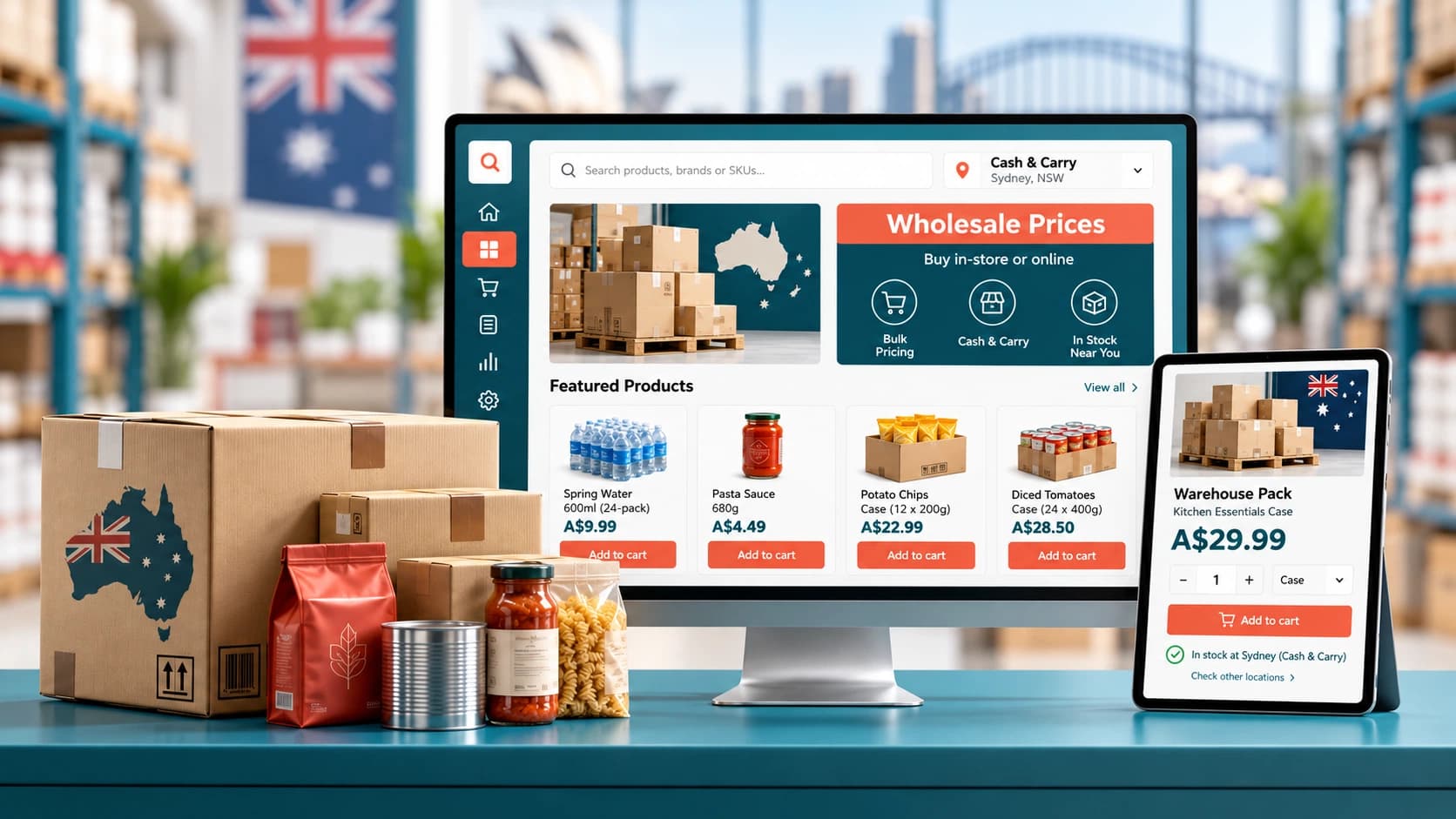

In Britain, the phrase cash and carry immediately suggests a trade warehouse: retailers, caterers and other businesses arrive, choose stock, pay and leave with it.
Australia has the same underlying model, but the modern version is less about insisting that every customer drives to a depot. Current operators combine branches with online ordering, click-and-collect, mobile ordering and scheduled delivery. Campbells, for example, currently offers online and app ordering, 14 branches nationally, click-and-collect and metro delivery.
That distinction matters because Australia is not a compact market. A model that works around Sydney or Melbourne can become uneconomic if it assumes the same customer density across regional Queensland, Western Australia or the Northern Territory.
For a new entrant, the opportunity is therefore not simply to recreate a British warehouse. It is to build a trade-first wholesale hub where customers can collect when price and speed matter, but order for delivery when distance matters more.
Does the Cash-and-Carry Model Fit Australia?
Yes – particularly for foodservice, convenience, independent retail and small hospitality businesses – but a pure walk-in model leaves too much of the Australian market outside an efficient driving radius.
Current operators already show the direction of travel: physical access still has value, but convenience now means channel choice. The strongest locations are likely to be industrial or trade areas with good vehicle access and a dense catchment of restaurants, cafés, convenience stores and independent retailers. In regional markets, a smaller depot with scheduled delivery routes may make more sense than a large walk-in warehouse.
Business Registration, ABN and GST
A cash-and-carry is not a special legal entity. You still choose an ordinary Australian business structure and complete the registrations that apply to it.
Most businesses need an Australian Business Number (ABN), which is used for dealings with government, customers and suppliers. If you trade under a name other than your own legal name, you may also need to register a business name; companies are registered separately through the Australian corporate system.
GST becomes compulsory when GST turnover reaches A$75,000. The Australian Taxation Office also requires a business that becomes liable to register within 21 days. For a serious wholesale operation, that threshold is normally reached quickly, so prices, tax invoices and accounting processes should be designed for GST from the beginning rather than treated as a later ecommerce setting.
State, territory and local permits are separate from federal business registration, so premises, food, liquor and tobacco requirements must be checked by location.
| Area | Australia-wide baseline | What changes locally |
| Business identity | ABN; company/business-name registrations as applicable | Planning, premises and activity permits can be state/local |
| GST | Registration required at A$75,000 GST turnover | Same federal system nationally |
| Food | Food Standards Code + notification to food regulator | Enforcement and licensing/registration handled by state/local authorities |
| Liquor | No single national wholesale liquor licence | State/territory licensing models differ |
| Tobacco | Federal product/tax rules may apply | Supplier licensing can be state-specific |
Food Wholesale: Notification, Traceability and Recalls
Food is where a general cash-and-carry quickly becomes a regulated food business. Under the Australia New Zealand Food Standards Code, a new food business must notify the relevant food regulatory agency before starting food-handling operations. In many areas that agency is the local council, although the responsible body varies by jurisdiction.
For a food wholesaler, record keeping is especially important. Food Standards Australia New Zealand says businesses that manufacture, supply food wholesale or import food must have a food recall system. A wholesaler should be able to identify where stock came from, which business customers received it, transaction dates, quantities and – where relevant – batch or lot identifiers.
If a supplier recalls one production lot, the ability to isolate affected customers quickly is operationally as important as the formal compliance requirement.
Importing Food and Selling by Weight or Measure
Imported ranges can make a cash-and-carry distinctive, particularly in ethnic grocery, hospitality and specialist foodservice. They also add another regulatory layer.
Food imported for sale must meet Australian biosecurity conditions and food standards. Importers use BICON to check conditions, and consignments may be referred to the Imported Food Inspection Scheme; food placed on hold cannot be distributed until released. Australia also has national trade-measurement rules, so goods sold by weight, volume, length or number – and pre-packaged goods – must carry accurate quantities and markings.
Alcohol and Tobacco: State Rules Matter
Do not build a regulated category into the range on the assumption that a general warehouse approval covers it.
Alcohol wholesale licensing is state or territory based. In New South Wales, for example, a producer/wholesaler liquor licence is the relevant licence for a business wholesaling liquor to other liquor licensees, and wholesale-only operators are not permitted to sell that liquor to the general public under that licence. Other jurisdictions have their own structures.
Tobacco is also increasingly licence-driven at state level. Queensland, for example, requires a smoking-product wholesale licence before a wholesaler can supply smoking products and requires separate licensing for more than one wholesale premises. The practical lesson is to check each state before adding regulated categories or opening another depot.
Where the Opportunity Actually Is
Australia’s geography creates the biggest weakness in a traditional cash-and-carry model, but also the clearest opportunity for a modern one.
A branch can offer the lowest-friction option to nearby trade customers: immediate stock access, no delivery wait and the ability to inspect products. Delivery can then extend the same inventory beyond the depot’s practical drive-time. Click-and-collect sits between the two.
This is especially attractive for independent hospitality and convenience customers that buy frequently but do not need complex procurement systems. Collection can carry the sharpest price, while regional delivery uses minimum-order values or transparent charges. The gap is not the absence of cash and carry; it is the need for a simpler bridge between self-service wholesale and delivered distribution.
A Practical Australian Cash-and-Carry Model
A sensible launch model would use one depot as both warehouse and trade counter, give approved business customers account access, publish live or near-live stock, and offer three fulfilment choices: walk-in purchase, click-and-collect and scheduled delivery.
The system should know each customer’s price, what stock is genuinely available and which postcodes are economical to serve. Food operations should also make supplier, lot/batch and customer records easy to retrieve, with licence or permit checks where regulated categories require them.
For Australia, the digital layer should extend the depot rather than compete with it. A hybrid operation works best when customer ordering, stock, pricing, collection and delivery are connected rather than run as separate channels. Simplisales Dashboard can manage customers, products, purchasing, inventory and warehouse activity, while the Simplisales Ecommerce Website and Simplisales Ecommerce App give trade buyers self-service ordering alongside branch, sales-rep and delivery workflows.
Final Thoughts
Cash and carry remains a viable Australian wholesale model, but the strongest version is hybrid rather than purely physical.
The legal baseline is manageable: establish the business correctly, register for GST when required, notify the appropriate food authority if you handle food and comply with national traceability, import and trade-measurement rules. The complexity increases when alcohol, tobacco or multiple jurisdictions are added.
Commercially, the winning proposition is likely to be straightforward: make collection cheap and immediate for customers close enough to use it, while using digital ordering and delivery to prevent Australia’s geography from becoming the limit of the business.
Official references and further reading
Australian Government – Register for an Australian Business Number (ABN)
Australian Taxation Office – Registering for GST
Food Standards Australia New Zealand – Starting or changing a food business
Food Standards Australia New Zealand – Food traceability
Department of Agriculture, Fisheries and Forestry – Importing food into Australia
National Measurement Institute – Trade measurement
NSW Government – Producer/wholesaler liquor licence
Business Queensland – Smoking product supplier licensing scheme
Related Blogs
Explore more insights for your wholesale business.
Cash and Carry · 09 OCT 2026
Cash and Carry in Canada
Start With the Canadian Market, Not the British Label Business Registration and a Multi-Layer Tax System Food Wholesale: Federal Licensing Depends on What You Do Traceability Can Apply More Broadly Than Licensing Alcohol Is a Provincial Distribution Question Tobacco Rules Are Provincial Too Where the Cash and Carry Opportunity Is Strongest Design the Depot […]
Cash and Carry · 05 OCT 2026
Cash and Carry in New Zealand
Cash and Carry Is Already a Familiar Model in New Zealand Business Registration and GST Food Distribution: National Programme 1 Is the Key Starting Point Importing Food: Registration Is Separate Alcohol Has an Unusual Wholesale Exemption Tobacco and Vaping Require Notifications Where a New Cash and Carry Can Compete Building the Right Hybrid Model Final […]
Run your business,
without the complexity
Start free · Try paid plans for 30 days.
