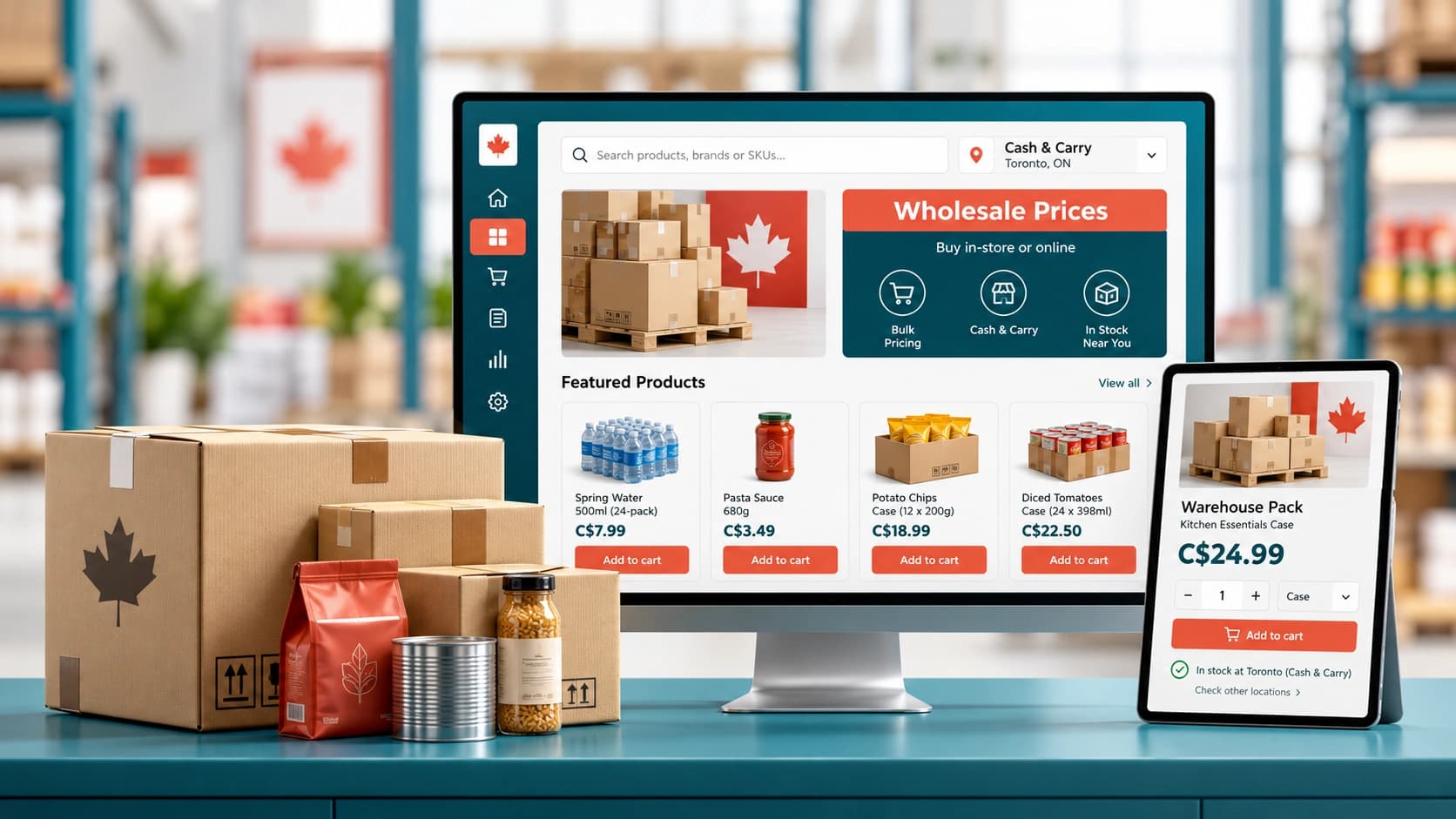

Start With the Canadian Market, Not the British Label
Business Registration and a Multi-Layer Tax System
Food Wholesale: Federal Licensing Depends on What You Do
Traceability Can Apply More Broadly Than Licensing
Alcohol Is a Provincial Distribution Question
Tobacco Rules Are Provincial Too
Where the Cash and Carry Opportunity Is Strongest
Design the Depot Around Pickup and Delivery
Final ThoughtsTableOfContentss==
A British operator looking at Canada might search for ‘cash and carry’ and conclude that the format is less established. The model is there; the vocabulary is different. Canadian buyers are more likely to encounter Wholesale Club or Business Centre formats, often combining walk-in pricing with business delivery.
The real complication is that Canada is not one regulatory market. Federal food rules sit alongside provincial tax and product regulation, while areas such as alcohol distribution can work very differently from one province to another.
Start With the Canadian Market, Not the British Label
For a new cash and carry, terminology is more than branding. Calling the concept a ‘Business Centre’ or ‘Wholesale Club’ may communicate the proposition more naturally to Canadian buyers than importing UK language unchanged.
The physical format also needs localisation. Large urban regions can support high-volume self-service wholesale, but long distances make a national walk-in-only model unrealistic. Costco Business Centre already illustrates a useful principle: walk-in prices can be lower while delivery prices reflect the cost of logistics.
Business Registration and a Multi-Layer Tax System
Canada allows federal or provincial/territorial incorporation. A federally incorporated company may still need extra-provincial registration in each province or territory where it conducts business.
The Canada Revenue Agency uses a nine-digit Business Number (BN) for tax and programme accounts. GST/HST registration is generally compulsory once a business exceeds the C$30,000 small-supplier threshold, although voluntary registration is possible in eligible cases.
Sales tax also changes by destination and product. Ontario currently uses 13% HST, Nova Scotia 14%, most other HST provinces 15%, while non-participating provinces apply 5% federal GST plus any separate provincial sales tax; Quebec also has QST. Basic groceries are generally zero-rated for GST/HST. A Canadian ordering system therefore needs proper place-of-supply tax logic, especially for interprovincial delivery.
| Area | Federal baseline | Provincial / local complication |
| Business registration | BN and federal tax accounts; federal incorporation available | Extra-provincial registration and local permits may apply |
| Sales tax | GST/HST framework; C$30,000 small-supplier threshold | HST/PST/QST treatment varies by province and place of supply |
| Food | SFCR licensing for activities such as import and certain interprovincial trade/preparation | Provincial and municipal food-premises rules still apply |
| Alcohol | No single national private-wholesale model | Distribution and retail structures differ sharply by province |
| Tobacco | Federal excise/product rules | Wholesaler permits and tobacco-tax rules can be provincial |
Food Wholesale: Federal Licensing Depends on What You Do
A food wholesaler should not assume that ‘selling food’ automatically means one federal licence – or that no federal licence is needed because the warehouse is provincially registered.
Under the Safe Food for Canadians Regulations (SFCR), licensing is activity-based. Businesses that import food, or prepare food for export or interprovincial trade, are among those that require a Safe Food for Canadians licence. Importers may also need a written preventive control plan, supplier controls, recall procedures and traceability records.
A wholesaler that simply buys finished food in Canada and resells it within one province is not automatically required to hold an SFC licence merely because it is a wholesaler. But importing, repacking, labelling, processing or regulated interprovincial activity can change the answer quickly – particularly where imported or private-label ranges are part of the proposition.
Traceability Can Apply More Broadly Than Licensing
The federal traceability rules are deliberately broader than the licensing rules. CFIA guidance states that some traceability obligations apply to wholesalers and distributors that trade food across provincial or territorial boundaries even where the business model is mainly distribution.
The practical standard is familiar: identify the product, trace it one step back to the immediate supplier and one step forward to the immediate business customer. Importers must also keep traceability records.
For a cash and carry serving both businesses and consumers, customer type matters: B2B sales need enough information to identify the business customer, making a trade-account model useful for compliance as well as pricing.
Alcohol Is a Provincial Distribution Question
Alcohol is where a Canadian expansion plan can fail if it assumes there is a national equivalent of a UK wholesale licence.
In Ontario, the regulatory structure does not simply issue private ‘wholesaler licences’ to ordinary applicants; Ontario Regulation 746/21 expressly states that the Registrar shall not issue licences to operate as a wholesaler. The LCBO remains a central wholesale supplier in parts of the retail system, including licensed convenience and grocery stores.
In Alberta, the structure is different again. AGLC controls the wholesale framework, applies provincial markup and uses approved warehousing/distribution arrangements such as Connect Logistics Services, while some Alberta manufacturers can self-distribute under the rules that apply to them.
Alcohol therefore cannot simply be added as another national aisle. Each province needs a separate route-to-market review before premises, pricing and supplier contracts are designed.
Tobacco Rules Are Provincial Too
Tobacco has the same provincial warning sign. Federal excise and product rules exist, but wholesale permits and tobacco-tax administration can sit at provincial level.
Ontario, for example, requires a wholesaler’s permit under its Tobacco Tax Act if a business sells tobacco products for resale. Before supplying a retailer, the wholesaler must confirm that the retailer holds the required permit or qualifies under the applicable First Nations system.
A multi-province cash and carry should therefore treat tobacco as a controlled category with province-specific onboarding and customer-verification rules.
Where the Cash and Carry Opportunity Is Strongest
Canada’s size makes the opportunity highly local. A depot in Greater Toronto, Montréal, Calgary or another dense commercial market can serve nearby restaurants, caterers, convenience stores and independent retailers, but the same branch cannot economically serve distant customers as a walk-in-only model.
The opportunity is to combine urban pickup economics with regional delivery discipline: use the warehouse as a trade store for nearby customers and a pick-and-pack hub for scheduled deliveries. Provincial differences also favour a staged rollout, getting tax and regulated-category rules right in one province before expanding.
Design the Depot Around Pickup and Delivery
The physical warehouse should be designed around commercial flow: easy vehicle access, pallet and case quantities, a fast trade checkout, click-and-collect staging and a separate area for delivery picking.
Digitally, customers should see the price, tax treatment, pack size and stock relevant to their account and location. Delivery eligibility should be postal-code driven, with minimum orders or surcharges reflecting real logistics costs. The result is a local wholesale hub with two fulfilment economics: pickup and delivery.
For Canada, the technology layer needs to understand that tax, inventory and customer eligibility can change by province and fulfilment route. A hybrid operation works best when customer ordering, stock, pricing, collection and delivery are connected rather than run as separate channels. Simplisales Dashboard can manage customers, products, purchasing, inventory and warehouse activity, while the Simplisales Ecommerce Website and Simplisales Ecommerce App give trade buyers self-service ordering alongside branch, sales-rep and delivery workflows.
Final Thoughts
Canada is a strong market for warehouse-style B2B wholesale, but it rewards localisation.
A cash and carry can work well in dense business markets, especially when it combines walk-in value with business delivery. The legal design, however, has to be built around federal and provincial layers: GST/HST and provincial sales taxes, CFIA food licensing and traceability, and province-specific alcohol and tobacco structures.
The biggest mistake would be to launch a single national template and treat compliance as a settings exercise afterwards. The better approach is province first, category second, channel third: choose the first market, map the regulated categories, then build pickup and delivery around the economics of that region.
Official references and further reading
Canada Revenue Agency – Business number and CRA programme accounts
Canada Revenue Agency – When to register for GST/HST
Canada Revenue Agency – GST/HST rates and place-of-supply rules
CFIA – Licensing under the Safe Food for Canadians Regulations
CFIA – Regulatory requirements: Traceability for food
CFIA – Importing food to Canada: overview
Ontario Regulation 746/21 – Licensing (liquor)
AGLC – Warehouse and distribution
Ontario – Tobacco Tax: wholesaler permits
Related Blogs
Explore more insights for your wholesale business.
Cash and Carry · 05 OCT 2026
Cash and Carry in New Zealand
Cash and Carry Is Already a Familiar Model in New Zealand Business Registration and GST Food Distribution: National Programme 1 Is the Key Starting Point Importing Food: Registration Is Separate Alcohol Has an Unusual Wholesale Exemption Tobacco and Vaping Require Notifications Where a New Cash and Carry Can Compete Building the Right Hybrid Model Final […]
Cash and Carry · 02 OCT 2026
Cash and Carry in Australia
In Britain, the phrase cash and carry immediately suggests a trade warehouse: […]
Run your business,
without the complexity
Start free · Try paid plans for 30 days.
