Why Accounting Software Is Not Enough for Growing B2B Businesses
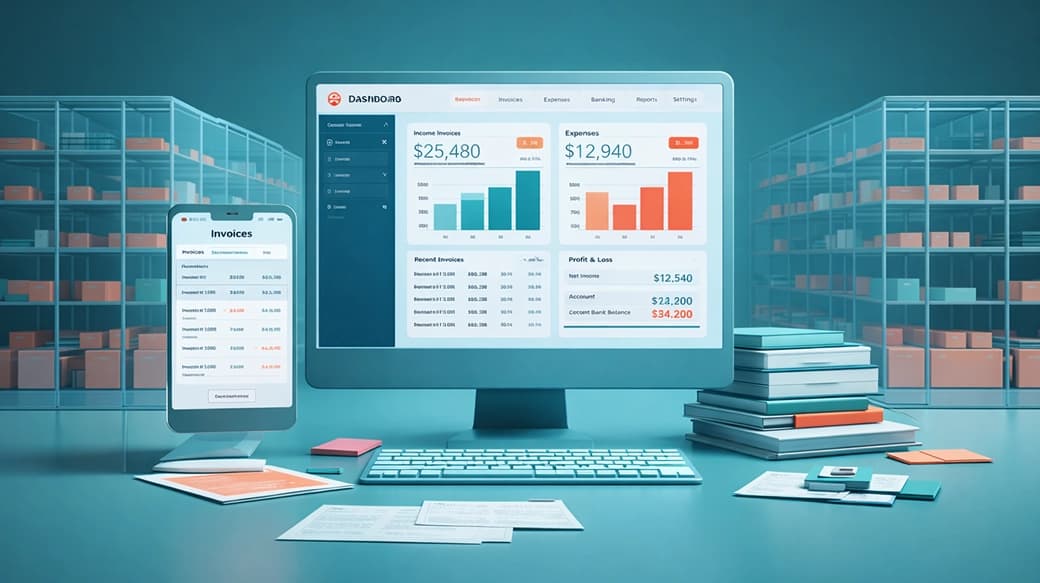

The Role of Accounting Software in Early-Stage Businesses
Persona
Founders, finance managers, and owner-operators are in the early-stage B2B sector.
Pain
They require real-time visibility into cash flow, invoices, VAT, and compliance.
Category
General-purpose accounting software (e.g., Xero, QuickBooks, Sage).
Initially, accounting software is crucial and suitable. It offers:
- Financial statements
- Tax and VAT compliance
- Invoicing and payments
- Basic customer records
For small teams that deal with fewer orders, this is sufficient. The issue does not arise here; it surfaces when the business progresses in operations, not in finance.
What Accounting Tools Do Well — and Where They Stop
Software for accounting focuses on financial aspects rather than operational status.
What accounting software is capable of managing successfully
- General ledger & bookkeeping
- Invoices & credit notes.
- Profit & Loss & Balance Sheet.
- Tax calculations and submissions.
Where accounting software shows its inadequacy
- Effective inventory management in real time.
- Stock control in multiple warehouses.
- Sales representative order acquisition.
- Partial shipments and backorders.
- Operational forecasting.
Deep operational complexity is purposely avoided by Accounting platforms. This is not an error; it is a design choice.
Inventory, Orders and Warehouse: The Missing Layer
Persona
Wholesalers who are growing and selling through a number of different channels, including sales reps or stores.
Pain
Stock quantities are right in accounting but are not in the right places at the warehouse.
Category
B2B wholesale order management and inventory systems
As order volume increases, companies often start taking care of:
- Inventory in spreadsheets
- Orders via emails, WhatsApp, or PDFs
- Sales reps not linked to core systems
- Warehouse operations are carried out manually
This generates a shadow system, where operational information is kept not only on the accounting system but in other places as well.
The outcome is increased delays in shipments, unsuitable sales, bad customer experience, and disputes between sales, warehouse, and finance personnel.
Why Growing Wholesalers Hit an Operational Wall
The wall typically manifests when one or more of the following occurs:
- The order volume rises more quickly than the number of hires
- Sales teams require online or self-service ordering
- Inventory is located in different locations
- Clients request faster service along with precise fulfilments
In this part, the accounting software transitions from being a control system to a reporting endpoint.
A lot of wholesalers go beyond the accounting tools which are programmed for this, rather than increasing efficiency, heightens risk.
How Businesses Scale Operations Without Replacing Accounting Systems
Empirical proof, scaling can exist without any changes in accounting software.
Rather, the B2B companies are growing append a functional layer that integrates with finances.
The layer usually consists of:
- B2B ordering portals
- Sales rep ordering apps
- Real-time inventory management
- Warehouse fulfilment workflows
- Central operational dashboards
Accounting software remains the financial source of truth, while operational systems manage orders, stock, and execution.
Accounting Software vs Operational Systems
| Capability | Accounting Software | B2B Operational System |
| Financial reporting | Yes | No |
| Tax & VAT compliance | Yes | No |
| Real-time inventory | Limited | Yes |
| Multi-warehouse control | No | Yes |
| Sales rep ordering | No | Yes |
| Customer self-service | No | Yes |
| Operational forecasting | No | Yes |
| Integration with accounting | N/A | Yes |
This separation of responsibilities is how modern wholesalers scale without losing control.
Real Customer Story: Operational ROI in Practice
One of the prominent wholesale distributors in the United Kingdom, with more than 3,000 different stock-keeping units (SKUs), had primarily relied on accounting software and spreadsheets for its operation
Before:
- The inventory accuracy was recorded at less than 80%
- Orders were re-entered into the accounting system by hand
- The sales and warehouse teams were frequently at odds regarding stock availability
After integrating a B2B operational platform:
- The inventory accuracy was raised to 98%
- The time spent on order processing was reduced by 45%
- Sales reps directly placed orders into the system
- The accounting software remained as it was
The measurable result was operational ROI without any interruption to finance or compliance workflows
Frequently Asked Questions
When does accounting software alone not suffice for a B2B business?
When the volume of orders, the complexity of inventory, or the number of sales channels increase beyond the limits of simple invoicing and bookkeeping.
Is it necessary for wholesalers to replace accounting software?
No. Most enterprises maintain their accounting system and integrate it with operational tools.
Is inventory management a feature of accounting software?
Only in a very basic sense. Inventory management is primarily concerned with stock value tracking, but it does not track operational stock flow.
What sets accounting apart from inventory management?
Accounting reflects the financial consequences of inventory actions. Inventory management deals with real-time stock control.
What category of software do expanding wholesalers integrate?
B2B wholesale ordering, inventory, and warehouse management platforms which integrate with accounting.
Conclusion
Experience a seamless B2B e-commerce journey with Simplisales.
The future is bright for wholesale businesses. Make it brighter with Simplisales, a simple and affordable B2B e-commerce solution for wholesalers.
Although accounting software is essential, it is inadequate for thriving B2B wholesalers. The limitation does not lie with the tool – it is in the role it was intended to fulfil. Companies that thrive do not compel accounting platforms to handle operations. They layer in the proper operations, keep the finances clean, and reclaim their control as they expand.
References
Cloud Easer Consulting – 10 Reasons Why Your Accounting System Should Not Manage Your Inventory
advantive – Why Distributors Need More Than Accounting Software
DOit ERP – Why Accounting Software Alone Isn’t Enough Anymore
Related Blogs
Explore more insights for your wholesale business.
Accounting · 23 MAR 2026
Integrating On-Premise Accounting Systems with Modern Operations
As B2B businesses grow, the real challenge is not outdated accounting software, but the lack of connection between stable on-premise systems and fast-moving operational processes like sales, inventory and warehouse management. Tools such as Sage 50 remain reliable for finance, compliance and reporting, but they are not designed to handle real-time operations, leading to delays, […]
Accounting · 02 FEB 2026
When Inventory Outgrows Accounting Tools
The problem with inventory in the case of growing wholesale businesses usually comes not from the errors but from the mere dependency on accounting software for the wrong job. The accounting systems are super precise when it comes to cash flow and stock value, but they see inventory as a definite figure that is updated […]
Accounting · 02 JAN 2026
Integrating Accounting Software with Inventory and Warehouse Systems
As wholesalers grow, accounting software alone can no longer keep up with the real-time demands of inventory and warehouse operations, leading to mismatched numbers, manual checks and daily friction between finance, sales and warehouse teams. Accounting systems are built for financial accuracy and compliance, while inventory and warehouse systems reflect what is actually happening on […]
Run your business,
without the complexity
Start free · Try paid plans for 30 days.
