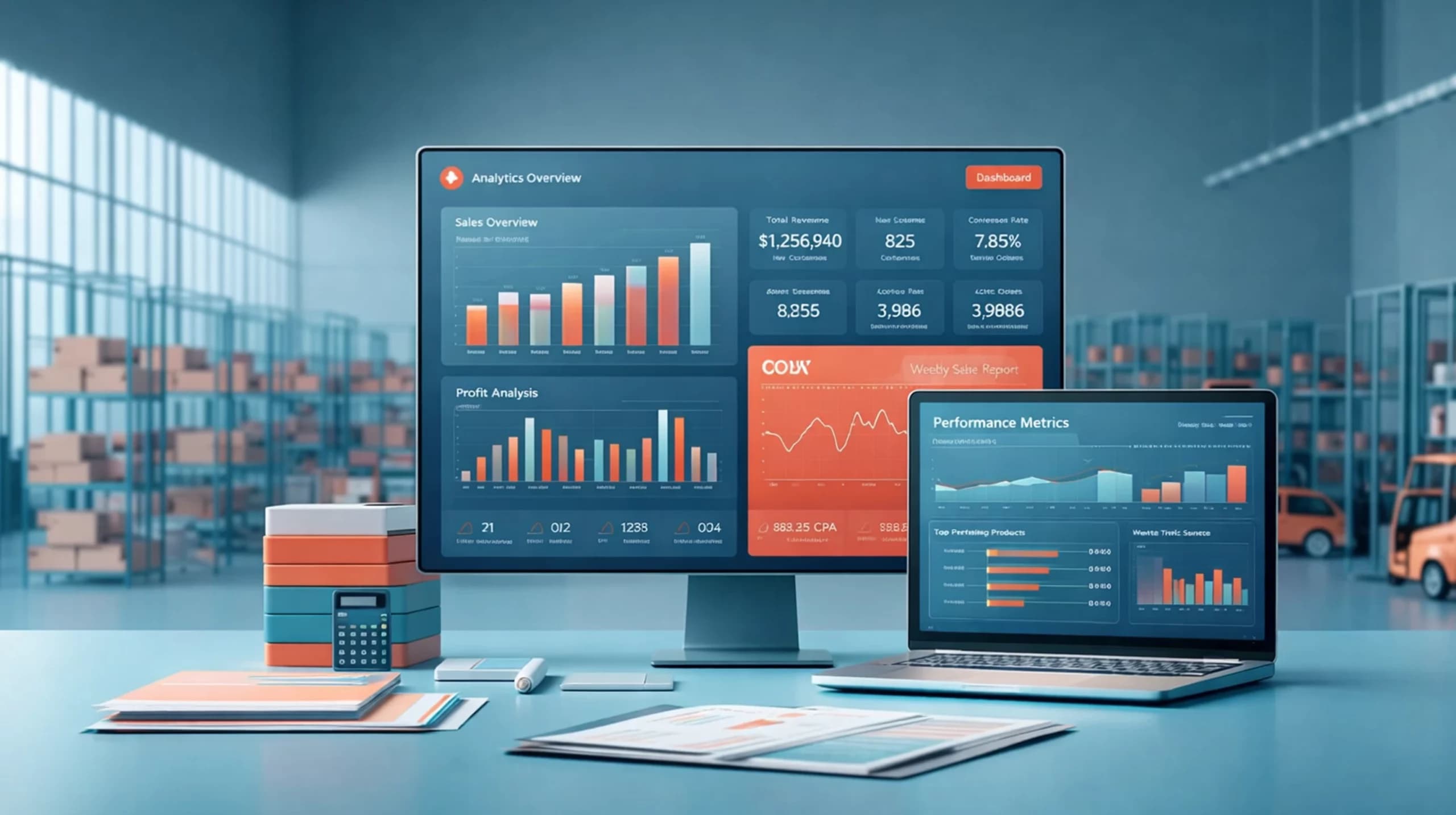

There is no growing wholesale business which can doubt that there’s a time when things start to get a little… off.
Your accounting software indicates that stocks are accessible.
Your warehouse counters this claim.
Sales say they shipped it yesterday.
Finance guarantees that the numbers are okay.
Here you are standing at the centre of it all, and you might wonder, “How did the inventory issue become the toughest part of the company?”
The bitter truth is this: accounting software was never intended to manage inventory-heavy operations. The software can only keep records of stock values, but once the product line, order quantity, and complexity of fulfilment increase, the inventory honestly becomes more than the accounting tools can handle.
How Accounting Systems Actually Handle Inventory
To have a clear view of what accounting software can accomplish, I would like to emphasise the following functionalities.
The accounting software is absolutely amazing for:
- Recording stock value
- Tracking purchases and sales financially
- Producing balance sheets and reports
Nevertheless, the treatment of inventory in the accounting program is usually like a number that is not updated by any transactions.
The majority of programs regard the following things as the standard:
- One central stock location
- Straightforward in/out movements
- Updating only happens after the transaction is completed
Such an assumption can be easily used when you are small. It also works well when the volume is reasonable. Moreover, it is effective when the stock is not of prime importance.
However, wholesaling is not like that at all.
When Inventory Becomes Operational, Not Just Financial
When you are moving your business to a bigger stage, the inventory does not stay just a line in the report anymore, but it becomes the operational engine.
You find yourself suddenly facing:
- Multiple warehouses or inventory locations
- Reserved stock to fulfil open sales orders
- Back orders and partial fulfilments
- Sales representatives in the field, at the time of any suggestion of the product, say that it is available in real time
This is the moment when the accounting tools come up with their limits.
You will come across questions like:
Is this stock unallocated, or is it already sold?
Where exactly is it located?
Why does accounting report that we have it, but the person picking can’t find it?
None of these are accounting questions. They are the inventory management problems.
Common Inventory Problems in Growing B2B Companies
The first sign of inventory outgrowing accounting is always similar to the symptoms.
The stock accuracy declines.
Warehouse employees begin to mistrust the figures in the system.
Sales are cautious or may even be overly sure of themselves.
Some of the common problems are:
- Selling the stock that has been previously allocated
- Keeping extra safety stock, which is not needed “just in case”
- Doing manual reconciliations between two systems
- End-of-month unexpected variances
What makes the situation really dangerous is that the figures look correct until they no longer do.
Stock Accuracy Is About Movement, Not Balance
Accounting systems look at balances.
Inventory systems concentrate on movement.
That is the point.
The actual inventory accuracy is based on the following:
- Updates in real time
- Visibility at the location level
- Order reservations
- Transfers between warehouses
For example, an accounting system may show that you have 1000 units in hand.
The operational system will instead show you:
- 600 units are in Warehouse A
- 300 units are reserved
- 100 units are damaged or in transit
Only one of these helps you make decisions.
With Simplisales Dashboard, inventory is viewed as a real operational asset instead of a static financial record. Stock moves with the order. Availability changes as the demand changes. Everyone sees the single truth.
Real-Time Inventory vs Static Records
The major concern with accounting tools is timing.
Usually, inventory updates occur in the following order:
- After posting invoices
- After manual adjustments
- After reconciliation
This is already too late.
Real-time inventory means:
- Sales can see the actual availability
- Customers do not immediately order products that you cannot fulfil
- Purchasing is proactive in avoiding the shortage of goods
The Simplisales Website makes sure that the customers see the realistic availability when they order, while the Simplisales App gives the same confidence to the sales reps in the field.
No more double-checking. No need for awkward follow-ups.
Why Replacing Accounting Is the Wrong Move
During tough inventory times, numerous organisations commit a huge error in their thinking:
We should replace the accounting software.
The truth is that accounting is hardly ever the issue.
However, the finance department still requires:
- Compliance
- Reporting
- Tax accuracy
The more practical way is to separate the duties.
Let accounting perform the functions it is proficient in.
Let inventory systems carry out the operations.
Precisely for this reason, the B2B platforms’ connection of inventory management to accounting is designed not to replace it, but alongside it.
Scaling Inventory Without Changing Accounting
You don’t have to destroy the whole management system to rectify the inventory issue.
You require:
- An operational inventory management system
- Real-time visibility across teams
- A clean integration with accounting
With Simplisales:
- Inventory management is done at the operational level
- Financial postings sync to accounting cleanly
- One source of truth is utilised by the teams
This is the way to strip off friction without adding complexity.
What Sales, Warehouse, and Finance Gain
If inventory emerges to be bigger than accounting tools and is managed accurately, every unit plays its role.
The sales team increases its self-esteem:
If it’s available, I can sell it.
Warehouse gains clarity:
The system matches what’s on the shelves.
Finance gains control:
Stock value is matched, and cash flow is easy to calculate.
Instead of being the subject of conflicts,the inventory turns into a shared property.
Final Thoughts: Inventory Is Too Important for Accounting Alone
Experience a seamless B2B e-commerce journey with Simplisales.
The future is bright for wholesale businesses. Make it brighter with Simplisales, a simple and affordable B2B e-commerce solution for wholesalers.
Conclusive Reflections: Inventory Shouldn’t Be Solely Related to Accounting
The inventory management software is designed to manage expeditious, multi-location, and high-volume inventory, while accounting tools are often not equipped to do so.
Accounting tools are for tracking that happened in the past.
Inventory systems are for tracking the present.
A situation where inventory exceeds the limitations of an accounting tool is not due to the failure of the software program; the finance department should replace it by developing a new inventory management system that should be used exclusively.
Using the combination of Simplisales App, Simplisales Website, and Simplisales Dashboard, wholesalers can achieve visibility seamlessly, accuracy without errors in detail, and scaling without the hectic.
References
Inventory Accuracy Matters — Inventory Accuracy: Why It Matters and How to Achieve It
Gartner — How to Stand Out in Your Category: Buyer Insights for Inventory Management Software
DHL — Inventory Accuracy: How to Calculate & Improve it | DHL Ireland
Related Blogs
Explore more insights for your wholesale business.
Accounting · 23 MAR 2026
Integrating On-Premise Accounting Systems with Modern Operations
As B2B businesses grow, the real challenge is not outdated accounting software, but the lack of connection between stable on-premise systems and fast-moving operational processes like sales, inventory and warehouse management. Tools such as Sage 50 remain reliable for finance, compliance and reporting, but they are not designed to handle real-time operations, leading to delays, […]
Accounting · 09 FEB 2026
Why Accounting Software Is Not Enough for Growing B2B Businesses
As a B2B wholesale business owner, you would depend a great deal on the accounting software that helps you to keep track of all the invoices, the revenue, and the taxes. On the flip side, it will not be unusual if you find yourself typing in the search engine “accounting software is not enough” or […]
Accounting · 02 JAN 2026
Integrating Accounting Software with Inventory and Warehouse Systems
As wholesalers grow, accounting software alone can no longer keep up with the real-time demands of inventory and warehouse operations, leading to mismatched numbers, manual checks and daily friction between finance, sales and warehouse teams. Accounting systems are built for financial accuracy and compliance, while inventory and warehouse systems reflect what is actually happening on […]
Run your business,
without the complexity
Start free · Try paid plans for 30 days.
